Essential Python Libraries for AI/ML Beginners (2026 Guide)
Discover essential Python libraries for AI and Machine Learning beginners including NumPy, Pandas, visualization tools, and Scikit‑learn. Learn the correct learning order, practical workflow, and real-world tips from Neody IT to start your AI journey faster.
Beginner Guide to Essential Python Libraries for AI/ML (2026 Roadmap)
The Practical Libraries Every AI/ML Beginner Should Learn First
Artificial Intelligence and Machine Learning are exciting fields, and many beginners start their journey by learning Python basics.
But after learning syntax, loops, and functions, most learners feel stuck.
They ask:
“Now what?”
Here’s the reality check.
Knowing Python syntax does NOT automatically mean you are ready for AI or Machine Learning.
Real-world AI/ML work focuses on:
Handling data
Analyzing data
Visualizing data
Training models
And this is where Python libraries become your superpower.
At Neody IT, we often see beginners trying to build everything from scratch - which slows learning dramatically. In real industry workflows, developers rely on powerful libraries that accelerate development and allow you to focus on solving problems instead of reinventing basic tools.
This beginner-friendly guide explains the essential Python libraries you actually need - in the correct learning order.
Why Python Libraries Are Important in AI/ML
Before jumping into specific tools, understand why libraries matter.
1. Time Saving
Libraries like NumPy or Scikit-learn already implement complex mathematics efficiently.
Instead of writing matrix calculations manually, you can use optimized functions.
Example:
Without libraries → write complex loops for matrix operations.
With NumPy → a single line of code performs fast vector calculations.
2. Industry Standard Tools
Professional AI engineers rely on these libraries daily. Learning them prepares you for real-world workflows.
3. Performance Optimization
Many libraries are written in optimized low-level languages behind the scenes, making them faster than pure Python.
4. Tested and Reliable
Libraries are widely used and battle-tested, reducing errors and saving development time.
Libraries are not shortcuts - they are industry standards.
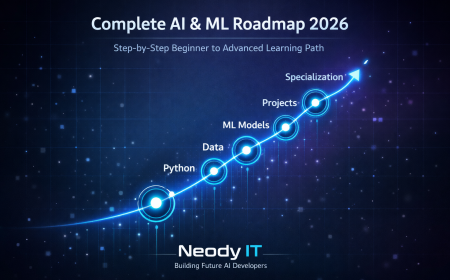
Learning Order - Beginner Friendly Flow
One of the biggest mistakes beginners make is learning tools randomly.
Follow this structured progression:
NumPy - Numerical operations foundation
Pandas - Data handling and cleaning
Visualization - Understanding patterns visually
Scikit-learn - Machine learning basics
This order mirrors how real AI workflows operate.
NumPy - Foundation of Numerical Computing
What is NumPy?
NumPy stands for Numerical Python.
It is designed for fast array processing and mathematical operations.
Why NumPy is Important for AI/ML
Machine learning models operate on numbers:
-
Vectors
-
Matrices
-
Multi-dimensional arrays
NumPy provides the backbone for these operations.
Key Concepts Beginners Should Learn
-
Arrays vs Python lists
-
Shape and dimensions
-
Indexing and slicing
-
Vectorized operations
-
Broadcasting (basic understanding)
Beginner Mistake
Treating NumPy arrays like normal Python lists.
NumPy is optimized for numerical operations - understanding this difference improves performance and code clarity.
Pandas - Real Data Ka King
What is Pandas?
Pandas is a powerful data manipulation library used to handle real-world datasets.
Why Pandas is Essential
Real-world data is messy:
-
Missing values
-
Inconsistent formatting
-
Duplicate entries
Cleaning and preparing data is often the biggest part of AI projects.
Around 70% of AI work involves data preparation.
Important Topics to Learn
-
DataFrame vs Series
-
Reading CSV or Excel files
-
Selecting rows and columns
-
Filtering data
-
Handling missing values
-
GroupBy basics
Practical example:
Analyzing sales data:
-
Load dataset
-
Remove missing values
-
Calculate total revenue by category
-
Prepare clean data for modeling
Data Visualization - Understanding Data Before Modeling
Many beginners skip visualization - and this is a major mistake.
Visualization helps you understand patterns before applying machine learning.
Key Libraries
Matplotlib
-
Basic plotting library
-
Full control and customization
Seaborn
-
Statistical visualization
-
Cleaner and more modern charts
Essential Visualization Types
-
Line plots
-
Bar charts
-
Histograms
-
Scatter plots
-
Correlation heatmaps
Visualization helps detect data errors early, saving hours later.
Scikit-learn - Machine Learning Ka Entry Gate
What is Scikit-learn?
Scikit-learn is a beginner-friendly machine learning library.
It simplifies training and evaluating models.
What Beginners Should Learn First
-
Train-test split
-
Linear regression
-
Logistic regression
-
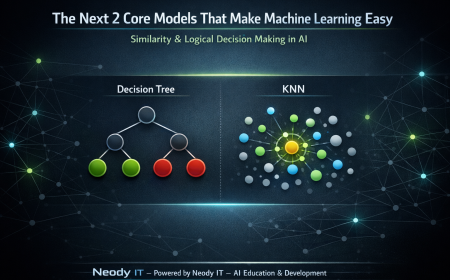
Decision trees
Typical Workflow
Load data → preprocess → train → predict → evaluate
Important reminder:
Don’t memorize algorithm names. Understand the workflow.
Common Beginner Mistakes (Very Important)
At Neody IT, these patterns appear repeatedly:
-
Getting stuck in tutorial hell
-
Copy-pasting code without understanding
-
Skipping visualization
-
Starting modeling without understanding data
-
Learning too many libraries at once
Avoiding these mistakes accelerates progress dramatically.
Practice Strategy - Real Growth Method
Theory alone doesn’t work.
Start small projects like:
-
Student marks analysis
-
Sales data analysis
-
Simple prediction model
Learning formula:
Load data → Clean → Visualize → Train simple model
Repeat this cycle to build strong intuition.
Tools Setup (Optional but Useful)
Recommended beginner environment:
-
Jupyter Notebook
-
Google Colab (best for beginners - no setup required)
These tools help you experiment faster.
Final Advice - Learning Mindset
Successful learners follow a different approach:
-
First understand, then apply
-
Read code - don’t blindly copy
-
Visualization is a thinking tool, not decoration
Learning libraries is not about memorizing functions - it’s about understanding how data flows through the workflow.
Conclusion - Start Smart, Grow Faster
If you came here from a reel or Instagram content (hello lofer.tech audience), here’s your starting point:
Begin with NumPy today.
Move to Pandas next.
Practice visualization before jumping into deep learning.
AI/ML becomes easier when your foundations are strong.
And at Neody IT, we always emphasize one principle:
Strong basics lead to faster growth.
What's Your Reaction?
 Like
5
Like
5
 Dislike
0
Dislike
0
 Love
2
Love
2
 Funny
0
Funny
0
 Angry
0
Angry
0
 Sad
0
Sad
0
 Wow
1
Wow
1