












Maths for AI/ML (2026 Roadmap): What You Actually Need
Learn the essential maths required for AI and Machine Learning in 2026 without feeling overwhelmed. This beginner‑friendly roadmap covers linear algebra, probability, statistics, and calculus basics with practical learning order and real AI applications.
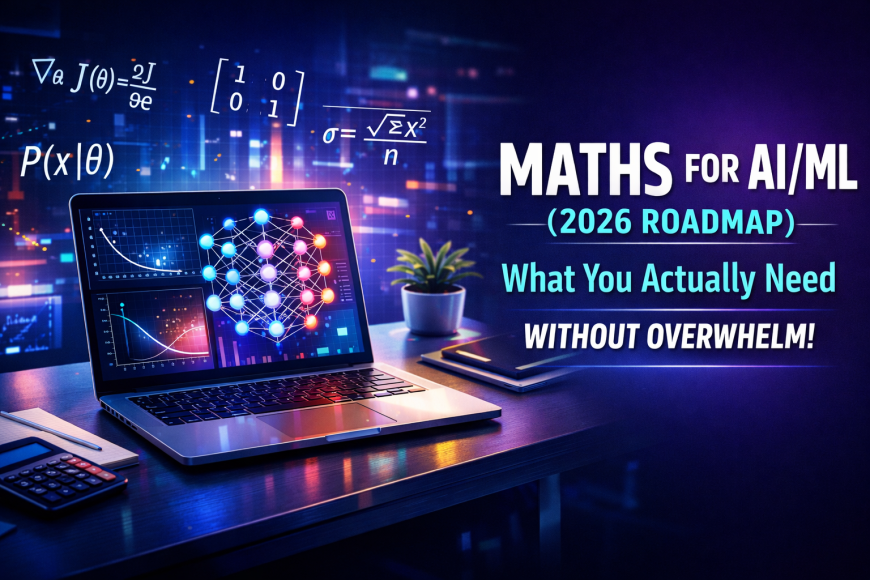
Maths for AI/ML (2026 Roadmap): What You Actually Need (Without Overwhelm)
A beginner-friendly guide to the real maths behind AI and Machine Learning
Artificial Intelligence and Machine Learning have exploded in popularity. Every beginner entering this field quickly hears the same intimidating message:
“You need advanced mathematics.”
This belief stops many people before they even begin.
The truth is very different.
You do not need PhD-level maths or complex theoretical proofs to start learning AI and ML. What you actually need is a clear understanding of core concepts and the ability to think logically about data.
At Neody IT and Lofar.tech, we’ve seen hundreds of beginners struggle not because maths is too hard, but because they try to learn everything at once without a clear roadmap.
This guide simplifies exactly what maths you need, when to learn it, and how to avoid overwhelm in 2026.
The Biggest Myth About Maths in AI/ML
One of the most common misconceptions is that AI requires deep academic mathematics from day one.
Many beginners assume they must master advanced calculus, complex proofs, or university-level mathematical theory before writing their first ML model.
Reality:
You don’t need to become a mathematician to begin.
AI learning starts with understanding ideas, not solving difficult equations.
A basic foundation in mathematical thinking is enough to start building models, experimenting with datasets, and learning practical machine learning.
The goal of this article is simple:
Give you a clear, realistic maths roadmap for AI without confusion or unnecessary complexity.
Why Maths Matters in AI/ML (Without Scaring Beginners)
Maths Helps You Understand “WHY,” Not Just “HOW”
Without maths knowledge, you can still run AI tools.
You can load datasets, train models, and get results.
But you may not understand:
Why a model behaves in a certain way
Why predictions change after tuning parameters
Why your model fails or overfits
Mathematics provides the conceptual understanding behind these decisions.
It turns you from someone who uses AI tools into someone who understands AI systems.
Coding vs Understanding
Many beginners can copy ML code from tutorials.
Fewer understand what is actually happening inside the model.
Maths bridges this gap.
When you understand the mathematical ideas behind machine learning, debugging becomes easier, experimentation becomes smarter, and learning accelerates significantly.
Level 1: Linear Algebra Basics (The Language of AI)
What is Linear Algebra in AI?
At its core, AI works with numbers.
Images become grids of pixel values.
Text becomes numerical representations.
Datasets become structured tables.
Linear algebra provides the language for representing and transforming this numerical data.
Models operate by transforming vectors and matrices to find patterns.
Concepts to Learn First
You don’t need deep theory. Focus on intuitive understanding:
Vectors
A list of numbers representing features or data points.
Matrices
Tables of numbers used to represent datasets or transformations.
Matrix multiplication
Think of it as combining information from different sources.
Dot product
A way to measure similarity between two vectors.
Dimensions and shapes
Understanding how data structures align in computations.
What NOT to Focus on Initially
Avoid deep proofs or heavy theoretical derivations early.
Your goal is intuition, not academic mastery.
Level 2: Probability (Understanding Prediction)
Why Probability Matters
Machine learning models rarely produce absolute answers.
Instead, they calculate probabilities.
For example:
A classification model might say an image is a cat with 85% probability rather than declaring certainty.
Understanding probability helps you interpret model outputs correctly.
Core Concepts Beginners Need
Basic probability intuition
Conditional probability
Randomness versus patterns
Expected outcomes
These ideas help you understand why models make predictions and how uncertainty works in AI systems.
Real AI Connection
Classification models
Confidence scores
Predictive analytics systems
Probability is the foundation behind prediction.
Level 3: Statistics (Making Sense of Data)
Why Statistics is Essential
AI learns from data.
Statistics helps you understand how data behaves before training any model.
Without statistical awareness, beginners often misinterpret results or work with poor-quality datasets.
Foundations You Actually Need
Mean and median
Variance and standard deviation
Basic distributions
Outliers and data spread
These concepts help you understand trends, patterns, and anomalies in datasets.
Practical Importance
Data cleaning
Understanding bias in data
Model evaluation basics
Strong statistical intuition makes model results easier to interpret.
Optional Level (Later): Calculus Basics (Only When Needed)
This is where many beginners become overwhelmed unnecessarily.
You do not need advanced calculus immediately.
Later, as you explore deeper machine learning concepts, a basic intuition becomes useful.
Key ideas:
Slopes or gradients
Optimization concepts
Gradient descent
Simple explanation:
A machine learning model learns by adjusting itself step by step to reduce error. Gradient descent is simply the process of moving toward better predictions gradually.
Focus on understanding the idea rather than complex formulas.
Common Maths Mistakes Beginners Make
Many learning struggles come from avoidable mistakes:
Trying to learn advanced maths before coding anything.
Watching heavy academic lectures without practical context.
Memorizing formulas instead of understanding intuition.
Believing maths must be perfect before starting AI.
The best approach is learning maths alongside building real projects.
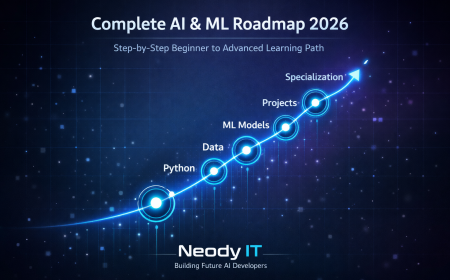
Practical Learning Order (Realistic Roadmap)
Here is a simple progression that works well for beginners:
Step 1: Learn basic Python programming.
Step 2: Develop linear algebra intuition.
Step 3: Understand probability basics.
Step 4: Build statistical foundations.
Step 5: Start working with ML models.
Step 6: Learn calculus concepts when needed.
Learning in this order prevents overwhelm and builds confidence steadily.
How to Learn Maths Without Feeling Overwhelmed
Most beginners struggle because they treat maths as a separate subject from programming.
Instead, try this approach:
Use visual explanations whenever possible.
Learn concepts through coding examples.
Practice maths alongside machine learning projects.
Focus on intuition first, formulas later.
When you see maths applied directly in code, concepts become easier to understand.
Closing Insight
AI and Machine Learning are not about becoming a mathematician.
They are about understanding enough mathematics to think logically about data, predictions, and model behavior.
You don’t need everything at once.
Start with fundamentals, build intuition gradually, and allow your mathematical understanding to grow naturally alongside your practical experience.
In 2026, the fastest learners are not those who know the most theory.
They are those who learn the right concepts at the right time.
What's Your Reaction?
 Like
2
Like
2
 Dislike
1
Dislike
1
 Love
0
Love
0
 Funny
0
Funny
0
 Angry
0
Angry
0
 Sad
0
Sad
0
 Wow
1
Wow
1