










Types of Machine Learning Explained and Beginner Roadmap (2026)
Learn the types of Machine Learning including supervised, unsupervised, and reinforcement learning with a clear beginner roadmap. This SEO-friendly guide explains ML concepts, real-world examples, and practical learning steps recommended by Neody IT for AI beginners.
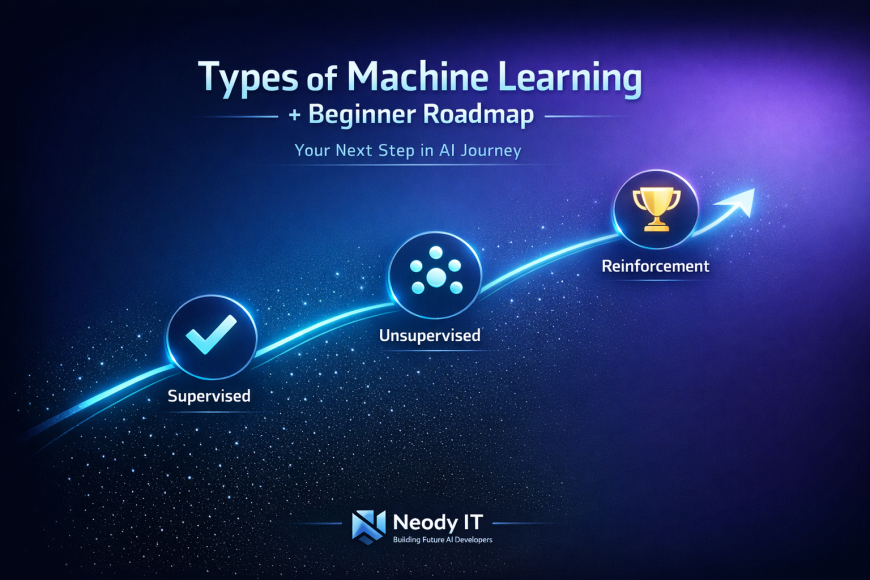
Types of Machine Learning Explained Beginner Roadmap
The Clear Next Step After Understanding Machine Learning Basics
After understanding what Machine Learning actually is, the next confusion most beginners face is understanding its different types and knowing what to learn next.
Many learners start exploring algorithms randomly without understanding the bigger structure behind Machine Learning. At Neody IT, we frequently see beginners jumping between tutorials, libraries, and complex models without a clear roadmap.
This guide is designed to remove confusion by explaining the main types of Machine Learning in simple terms and providing a beginner-friendly learning path that builds real confidence.
If you are coming from lofer.tech educational content or beginner reels, this article will give you the structured direction you need.
Understanding the Types of Machine Learning
Machine Learning can be broadly divided into categories based on how the system learns from data. Understanding these categories is important because it helps you choose the right approach for solving problems.
Supervised Learning
What Supervised Learning Means
Supervised learning is the most beginner-friendly and widely used type of Machine Learning.
In supervised learning:
-
Data comes with correct answers (labels).
-
The machine learns the relationship between input and output.
-
The goal is to predict correct outputs for new data.
You can think of it like teaching with examples where the answers are already known.
Real-Life Examples
Spam detection:
Email text is the input, and the label tells whether it is spam or not spam.
Marks prediction:
Study hours and previous performance help predict exam scores.
House price prediction:
House size, location, and features help estimate price.
Key Idea
Input plus correct output allows the machine to learn a mapping between features and results.
Once trained, the model uses this learned relationship to make predictions on unseen data.
Unsupervised Learning
What Unsupervised Learning Means
In unsupervised learning, there are no labels or correct answers provided.
The machine analyzes data and discovers hidden patterns or structures on its own.
Instead of predicting known outcomes, it focuses on finding similarities and grouping related data points.
Real-Life Examples
Customer segmentation:
Grouping customers based on purchasing behavior.
Pattern detection:
Identifying hidden trends in large datasets.
Recommendation systems can also use unsupervised techniques to understand user similarity.
Key Idea
The machine groups similar items together based on patterns it discovers automatically.
Reinforcement Learning (Short Introduction)
What Reinforcement Learning Means
Reinforcement learning is based on reward and punishment.
The system learns by interacting with an environment and improving its behavior based on feedback.
Examples
Game-playing AI systems.
Robotics learning tasks through trial and error.
For beginners, this category is useful to know conceptually, but it is not necessary to start with reinforcement learning early in your journey.
Common Myths About Machine Learning
Understanding these misconceptions helps beginners avoid unnecessary confusion.
Myth 1: Machine Learning Is Too Difficult
Reality: The core concept of Machine Learning is simple. Complexity comes later when building advanced systems, but beginner-level understanding is straightforward.
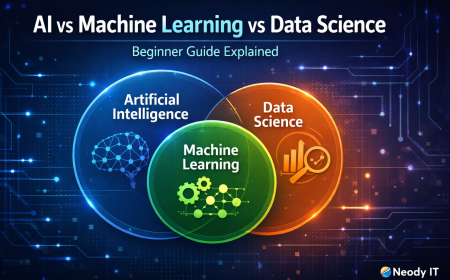
Myth 2: Machine Learning Equals Artificial Intelligence
Machine Learning is a subset of Artificial Intelligence.
Artificial Intelligence refers to broader intelligent systems, while Machine Learning specifically focuses on systems that learn patterns from data.
Myth 3: You Need Advanced Mathematics Before Starting
Advanced mathematics is not required initially.
Basic logic, foundational Python knowledge, and conceptual understanding are enough to begin learning and experimenting.
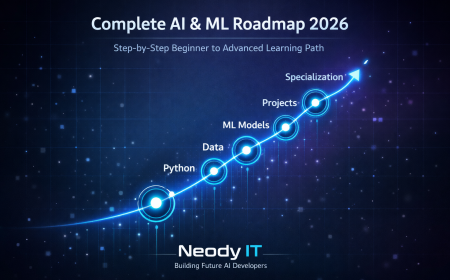
Beginner Roadmap: What to Learn Next
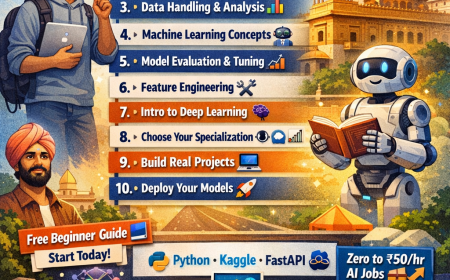
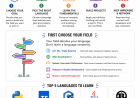
Many beginners ask what they should study after understanding Machine Learning concepts. This roadmap provides a practical order aligned with real-world workflows recommended at Neody IT.
Step 1: Python Basics
Focus on:
-
Variables and data types
-
Functions
-
Lists and dictionaries
-
Basic control flow
You do not need advanced Python mastery initially.
Step 2: NumPy and Pandas
Learn numerical operations and data handling.
NumPy helps with arrays and calculations.
Pandas helps with real-world data manipulation and cleaning.
Step 3: Data Understanding
Before building models, learn how to:
-
Explore datasets
-
Visualize trends
-
Identify patterns and outliers
Strong data understanding is often more important than algorithm complexity.
Step 4: Scikit-Learn
Start using beginner-friendly machine learning tools.
Learn:
-
Train-test split
-
Basic models like linear regression or decision trees
-
Model evaluation basics
Step 5: Build Your First Model
Start small.
Load a dataset, clean it, visualize it, train a simple model, and analyze predictions.
Practical experience builds confidence faster than theory alone.
Preview: Your First Machine Learning Model
In the next stage of learning, beginners should focus on building their first real model using:
-
Linear regression
-
A simple dataset
-
Train-test split
-
Prediction workflow
This step connects theory with hands-on practice and reinforces understanding.
Why This Two-Part Learning Strategy Works
At Neody IT, we encourage a structured approach:
Post 1 builds conceptual clarity by explaining what Machine Learning actually means.
Post 2 provides direction and a clear roadmap, helping beginners avoid confusion and information overload.
This method improves retention, builds confidence, and increases engagement because learners understand both the concept and the next steps.
Final Thoughts
Machine Learning becomes easier when you understand its structure.
Start by understanding the types of Machine Learning.
Then follow a structured roadmap that moves from fundamentals to practical application.
Avoid jumping randomly between advanced topics.
With consistent practice and clear direction, beginners can build strong foundations and grow steadily in AI and Machine Learning.
What's Your Reaction?
 Like
1
Like
1
 Dislike
0
Dislike
0
 Love
0
Love
0
 Funny
1
Funny
1
 Angry
0
Angry
0
 Sad
1
Sad
1
 Wow
1
Wow
1