

























First Machine Learning Models Every Beginner Must Learn
Learn the first two machine learning models every beginner should master: Linear Regression and Logistic Regression. This beginner-friendly guide explains regression vs classification, real-world examples, and ML foundations recommended by Neody IT for starting AI and machine learning.
The First Machine Learning Models Every Beginner Must Learn
Build a Strong Foundation Before Deep Learning
Machine Learning often feels overwhelming to beginners. Terms like neural networks, deep learning, TensorFlow, and PyTorch create excitement - but also confusion.
At Neody IT, we consistently see one major pattern:
Beginners jump into advanced topics before understanding the most basic models.
This article will remove that confusion by explaining the two most important Machine Learning models every beginner must learn first:
-
Linear Regression
-
Logistic Regression
If you understand these properly, Machine Learning becomes logical instead of intimidating.
Why Machine Learning Feels Difficult to Beginners
The Common Beginner Mistake
Most beginners:
-
Start directly with Deep Learning
-
Explore Neural Networks immediately
-
Use advanced libraries like TensorFlow or PyTorch
-
Follow complex tutorials without understanding fundamentals
This creates surface-level knowledge without conceptual clarity.
The Real Reason ML Feels Tough
Machine Learning becomes confusing when foundational models are skipped.
Advanced concepts only make sense when your basics are strong.
Before deep learning, you must understand simple learning models that teach:
-
How machines detect patterns
-
How predictions are made
-
How errors are reduced
Let’s start with the simplest one.
Model 1: Linear Regression (The Foundation of Prediction)
What is Linear Regression?
Linear Regression is the simplest Machine Learning model used to predict numerical values.
It answers questions like:
-
What will be the house price based on size?
-
What marks can a student expect based on study hours?
-
What salary might someone earn based on years of experience?
It predicts continuous numbers.
What Problem Does Linear Regression Solve?
Linear Regression solves regression problems.
A regression problem is where the output is a continuous number.
Examples:
-
75 marks
-
₹8,50,000 salary
-
23.5°C temperature
If your output is a number that can vary smoothly across a range, you are dealing with regression.
How Linear Regression Works (Conceptually)
Linear Regression tries to find a relationship between input and output.
Imagine plotting study hours on the X-axis and marks on the Y-axis. The model draws a “best fit line” that represents the relationship between them.
It works by:
-
Taking input data (independent variable)
-
Comparing it with actual results (dependent variable)
-
Minimizing prediction error
Important Beginner Concepts
Independent Variable (Input)
The factor you control or measure (for example, study hours).
Dependent Variable (Output)
The result you want to predict (for example, marks).
Error
The difference between the actual value and predicted value.
The model keeps adjusting the line to reduce this error.
This is called model training.
Why Every Beginner Must Learn Linear Regression
Linear Regression teaches you:
-
How machines learn patterns from data
-
How prediction works
-
What error means in Machine Learning
-
How models are trained
If you understand Linear Regression clearly, a large part of Machine Learning confusion disappears.
It builds strong intuition.
Model 2: Logistic Regression (The Foundation of Classification)
After learning how machines predict numbers, the next step is learning how they make decisions.
What is Logistic Regression?
Logistic Regression is used for classification problems.
It predicts categories instead of numbers.
Examples:
-
Spam or Not Spam
-
Pass or Fail
-
Fraud or Not Fraud
Instead of predicting a number like 75, it predicts a category.
What Problem Does Logistic Regression Solve?
It solves binary classification problems.
Binary means two possible outputs.
For example:
-
0 or 1
-
True or False
-
Yes or No
If your output belongs to categories instead of numbers, you are dealing with classification.
How Logistic Regression Works (Conceptually)
Logistic Regression does not directly predict categories.
It first predicts probability.
The output is always between 0 and 1.
For example:
If the model predicts 0.85 probability of spam, and your threshold is 0.5, then it classifies it as spam.
If the probability is 0.30, it classifies it as not spam.
Important Beginner Concepts
Probability
A value between 0 and 1 representing confidence.
Classification
Assigning data into categories.
Decision Boundary
The line or threshold that separates categories.
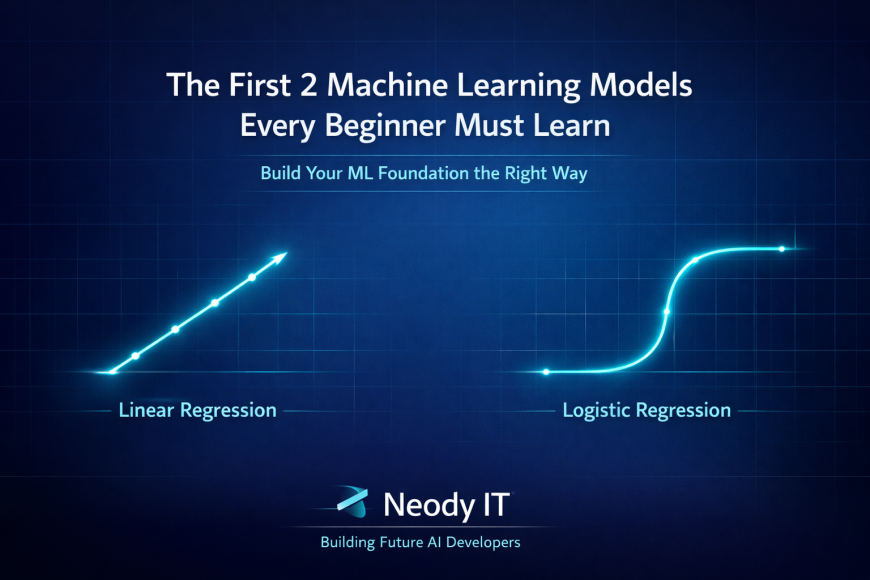
Logistic Regression uses an S-shaped curve instead of a straight line.
Key Difference: Linear vs Logistic Regression
| Linear Regression | Logistic Regression |
|---|---|
| Predicts numbers | Predicts categories |
| Used for regression problems | Used for classification problems |
| Straight line output | S-shaped curve output |
This difference forms the backbone of Machine Learning understanding.
Most ML problems fall into either:
-
Regression (predict numbers)
-
Classification (predict categories)
If you understand these two, you understand the foundation of ML.
Why These Two Models Build Real Confidence
At Neody IT, we strongly recommend beginners master these two models before exploring advanced algorithms.
Why?
Because they teach:
-
How training works
-
How prediction works
-
How errors are minimized
-
The difference between regression and classification
For the lofer.tech Instagram learners, this is the real starting point - not deep learning.
Strong fundamentals make advanced topics easier later.
Summary -
If you now understand:
Linear Regression - predicting numbers
Logistic Regression - predicting yes or no decisions
Then you understand the two most fundamental Machine Learning problem types:
Regression
Classification
Machine Learning is not complicated when broken into simple concepts.
Learn The Next 2 Core Models That Make Machine Learning Easy
What's Your Reaction?
 Like
19
Like
19
 Dislike
1
Dislike
1
 Love
4
Love
4
 Funny
1
Funny
1
 Angry
1
Angry
1
 Sad
3
Sad
3
 Wow
6
Wow
6