





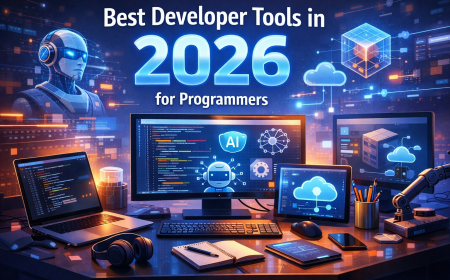


Best Developer Tools in 2026 for Programmers
Discover the best developer tools in 2026 including AI coding tools, IDEs, DevOps, and productivity tools to boost your development workflow.
The world of software development is evolving faster than ever. In 2026, developers are no longer limited to traditional IDEs and basic debugging tools. With the rise of artificial intelligence, cloud-native development, and automation, the modern developer toolkit has become more powerful and efficient than ever before.
Whether you are a beginner learning to code, a freelancer building client projects, or a startup scaling your product, choosing the right developer tools can significantly improve your productivity and code quality. In this guide, we will explore the best developer tools in 2026, covering everything from code editors to AI assistants, DevOps tools, and productivity platforms.
What Makes a Developer Tool the Best in 2026
Before diving into the list, it is important to understand what defines a great developer tool today.
A top developer tool in 2026 is not just about functionality. It is about how well it integrates into your workflow and enhances your efficiency. The best tools typically offer AI-powered assistance, fast performance, seamless integrations, strong community support, and a smooth developer experience.
Another important factor is adaptability. Tools that support multiple languages, frameworks, and environments are more valuable in modern development. Cost also plays a role, especially for freelancers and startups who prefer free or affordable solutions without compromising quality.
Best Code Editors and IDEs in 2026
Code editors remain the foundation of every developer’s workflow. In 2026, they have evolved into intelligent platforms that assist in writing, debugging, and optimizing code.
Visual Studio Code continues to dominate due to its lightweight nature and massive extension ecosystem. Its ability to integrate with AI tools and support almost every programming language makes it a top choice for developers.
JetBrains IDEs such as IntelliJ IDEA, PyCharm, and WebStorm are known for their powerful features and deep code intelligence. These tools are especially useful for large-scale projects where precision and advanced debugging are required.
AI-first editors like Cursor are gaining popularity. These editors are built around AI and allow developers to write code faster using natural language prompts. They are especially useful for rapid development and prototyping.
Neovim is still preferred by advanced developers who want full control and customization. Its speed and flexibility make it ideal for those who enjoy a keyboard-driven workflow.
Best AI Developer Tools in 2026
Artificial intelligence has transformed software development. AI tools are now essential for writing, reviewing, and optimizing code.
GitHub Copilot remains one of the most widely used AI coding assistants. It suggests code in real time and helps developers complete tasks faster. It is especially useful for repetitive coding patterns and boilerplate generation.
ChatGPT has become a powerful companion for developers. It helps with debugging, explaining code, generating scripts, and even designing system architectures. Many developers now use it as a daily problem-solving tool.
Codeium and Tabnine are also strong alternatives that provide AI-powered code completion and suggestions. These tools are often preferred for their speed and privacy-focused features.
Replit Ghostwriter is another emerging tool that simplifies coding directly in the browser. It is ideal for beginners and collaborative projects.
AI tools are not replacing developers, but they are significantly enhancing productivity by reducing manual effort and improving accuracy.
Version Control and Collaboration Tools
Version control is essential for managing code changes and collaborating with teams.
Git remains the backbone of version control systems. Platforms like GitHub, GitLab, and Bitbucket provide powerful interfaces for managing repositories, reviewing code, and collaborating with teams.
GitHub is widely used due to its simplicity and strong community. It also offers features like GitHub Actions for automation and CI/CD pipelines.
GitLab is preferred by organizations that need a complete DevOps platform with built-in CI/CD and security features.
Bitbucket is commonly used in enterprise environments, especially those already using Atlassian tools.
These platforms make collaboration easier by enabling pull requests, issue tracking, and seamless integration with development workflows.
Best Frontend Development Tools
Frontend development has become more dynamic and performance-focused in 2026.
React remains one of the most popular libraries for building user interfaces. Its component-based architecture and large ecosystem make it highly reliable.
Next.js has gained massive popularity for building full-stack applications with server-side rendering and improved performance.
Vue.js continues to attract developers who prefer simplicity and flexibility.
For styling, Tailwind CSS has become a go-to framework due to its utility-first approach. It allows developers to build modern designs quickly without writing extensive custom CSS.
Build tools like Vite have replaced older tools in many projects because of their speed and modern architecture.
Best Backend Development Tools
Backend development focuses on building scalable and efficient systems.
Node.js is widely used for server-side development due to its non-blocking architecture and strong ecosystem.
Frameworks like Express.js provide a minimal and flexible structure for building APIs.
Django remains a powerful choice for Python developers, offering built-in features for rapid development.
FastAPI is gaining popularity for building high-performance APIs with automatic documentation and type validation.
For API testing, tools like Postman and Insomnia are essential. They help developers test endpoints, debug issues, and ensure smooth communication between services.
Best DevOps and Deployment Tools
DevOps tools are crucial for automating development, testing, and deployment processes.
GitHub Actions is widely used for automating workflows directly within repositories. It simplifies CI/CD pipelines and reduces manual effort.
Jenkins is still relevant for complex enterprise setups where customization is required.
Docker has become a standard for containerization. It allows developers to package applications and run them consistently across different environments.
Cloud platforms like AWS provide powerful infrastructure for hosting and scaling applications. Vercel and Netlify are popular choices for frontend deployment due to their simplicity and speed.
Monitoring tools like Grafana and Prometheus help track performance and ensure system reliability.
Best Database and Backend Services
Databases are the backbone of any application.
MySQL and PostgreSQL remain the most popular relational databases. They are reliable, scalable, and widely supported.
MongoDB is a leading NoSQL database that works well for applications with flexible data structures.
Backend-as-a-Service platforms like Firebase and Supabase simplify backend development by providing ready-to-use authentication, databases, and APIs.
These tools allow developers to focus more on building features rather than managing infrastructure.
Best Productivity Tools for Developers
Productivity tools play a significant role in managing workflows and improving efficiency.
Notion is widely used for documentation, project planning, and knowledge management. It helps teams stay organized and aligned.
Slack is essential for team communication and collaboration. It integrates with many development tools and keeps conversations structured.
Jira and Linear are popular for task management and issue tracking. They help teams manage projects efficiently and track progress.
Tools like Raycast and Alfred enhance productivity by providing quick access to commands, files, and workflows.
Best Tools for Freelancers and Startups
Freelancers and startups need tools that are efficient, affordable, and easy to use.
All-in-one platforms that combine frontend, backend, and deployment capabilities are highly valuable. Tools like Vercel, Supabase, and Firebase enable rapid development and deployment.
No-code and low-code tools are also becoming popular for building MVPs quickly. They allow developers and non-developers to create functional applications without extensive coding.
Payment integrations, analytics tools, and automation platforms are also essential for managing business operations.
Free vs Paid Developer Tools
Choosing between free and paid tools depends on your needs and scale.
Free tools are often sufficient for beginners and small projects. Many open-source tools offer powerful features without any cost.
Paid tools are usually worth the investment for professional use. They provide advanced features, better support, and improved performance.
The key is to evaluate the return on investment and choose tools that align with your workflow and goals.
How to Choose the Right Developer Tools
Selecting the right tools can be overwhelming due to the vast number of options available.
Start by identifying your project requirements. Choose tools that align with your technology stack and development goals.
Consider your experience level. Beginners should focus on simple and user-friendly tools, while advanced developers can explore more complex solutions.
Avoid using too many tools at once. A streamlined toolkit is more effective than a cluttered one.
Focus on tools that improve productivity and reduce friction in your workflow.
Future of Developer Tools in 2026 and Beyond
The future of developer tools is heavily influenced by artificial intelligence and automation.
AI is expected to handle more repetitive tasks, allowing developers to focus on problem-solving and creativity.
Autonomous coding agents may become more common, assisting in building entire features with minimal input.
Cloud-native development will continue to grow, making deployment and scaling easier than ever.
Low-code and no-code platforms will also expand, enabling more people to participate in software development.
Conclusion
The best developer tools in 2026 are those that enhance productivity, simplify workflows, and adapt to modern development needs. From AI-powered coding assistants to powerful DevOps platforms, these tools are shaping the future of software development.
However, tools alone do not make a great developer. The key is to understand your needs, choose the right tools, and use them effectively.
If you want to stay ahead in the tech industry, start exploring these tools and integrate them into your workflow. For more guides, tutorials, and developer resources, keep following Neody IT.
What's Your Reaction?
 Like
0
Like
0
 Dislike
0
Dislike
0
 Love
0
Love
0
 Funny
0
Funny
0
 Angry
0
Angry
0
 Sad
0
Sad
0
 Wow
0
Wow
0

-
 CS YadavGood Info