














Types of Data Analytics: Descriptive, Predictive Guide
Learn the four types of data analytics: descriptive, diagnostic, predictive, and prescriptive. A complete beginner friendly guide by Neody IT.
Types of Data Analytics: A Complete Guide to Descriptive, Diagnostic, Predictive, and Prescriptive Analytics
Data has become one of the most valuable assets for modern businesses. Companies today collect huge amounts of information from websites, applications, marketing campaigns, and customer interactions. However, raw data alone does not provide value. The real power lies in analyzing that data and turning it into meaningful insights that help businesses make smarter decisions.
This is where data analytics comes in.
Data analytics is the process of examining data sets to identify patterns, trends, and insights that can guide business strategies and decision making. Organizations across industries including finance, healthcare, education, retail, and technology rely heavily on analytics to stay competitive.
At Neody IT, we frequently work with companies that want to transform their raw data into actionable insights through modern analytics systems and data driven platforms.
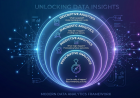
To understand how analytics works in the real world, it is important to learn the four major types of data analytics. Each type answers a different question and plays a unique role in decision making.
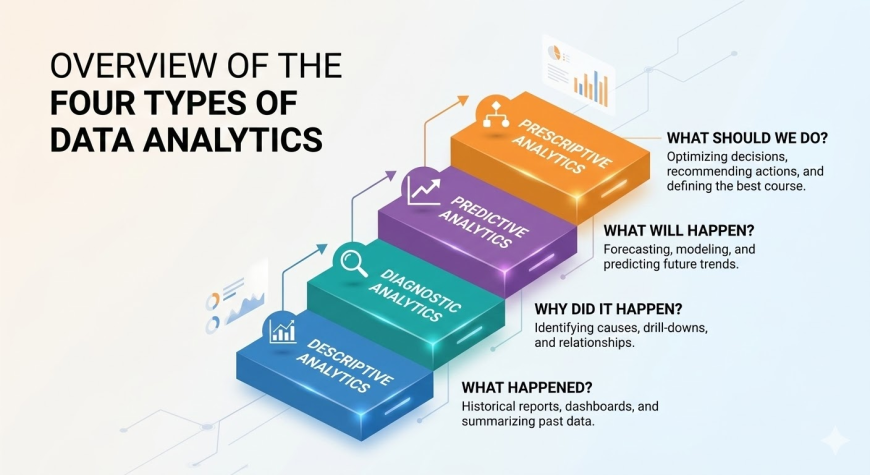
The four types of data analytics are:
Descriptive Analytics
Diagnostic Analytics
Predictive Analytics
Prescriptive Analytics
Together, these analytics approaches form a complete framework that helps businesses understand the past, analyze the present, and plan for the future.
Let us explore each of them in detail.
What Are the Types of Data Analytics?
The types of data analytics represent different ways of analyzing data depending on the objective of the analysis. Each type answers a specific question about business performance or behavior.
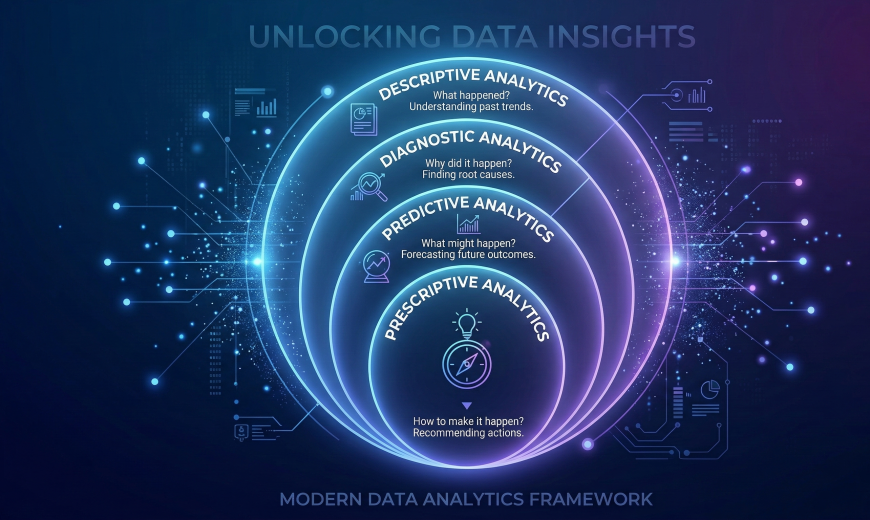
Descriptive analytics focuses on what happened.
Diagnostic analytics focuses on why it happened.
Predictive analytics focuses on what might happen in the future.
Prescriptive analytics focuses on what actions should be taken.
Think of these four types as a decision making ladder. Businesses usually begin with descriptive analytics and gradually move toward predictive and prescriptive analytics as their data maturity improves.
Modern technology companies, including Neody IT, help organizations build analytics pipelines that progress through all these stages to generate maximum value from their data.
1. Descriptive Analytics
What is Descriptive Analytics?
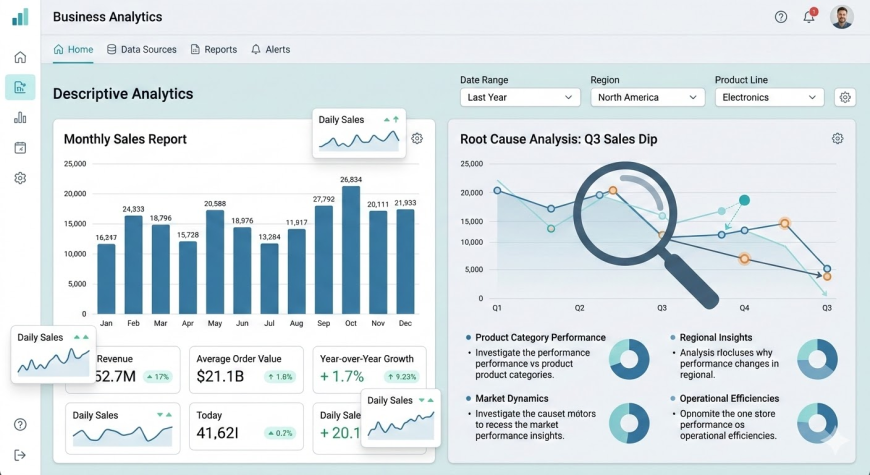
Descriptive analytics is the most basic and commonly used form of data analytics. It focuses on summarizing historical data to understand what has happened in the past.
In simple words, descriptive analytics answers the question:
What happened?
Businesses use descriptive analytics to track performance, monitor trends, and generate reports that summarize past activities.
Most dashboards, reports, and performance summaries fall under this category.
Examples of Descriptive Analytics
A monthly sales report showing total revenue for the last 12 months.
A website analytics dashboard displaying total visitors, page views, and bounce rates.
A social media performance report showing engagement metrics for the previous campaign.
A college management system analyzing student attendance statistics.
For example, if an ecommerce company looks at its dashboard and sees that sales in January were higher than December, that is descriptive analytics.
At Neody IT, we often build business dashboards that help organizations visualize their operational data through charts, graphs, and key performance indicators.
Common Tools Used in Descriptive Analytics
Some popular tools used for descriptive analytics include:
Microsoft Excel
Google Data Studio
Power BI
Tableau
SQL based reporting systems
These tools help analysts transform raw data into visual reports that are easy to understand.
Why Descriptive Analytics Matters
Descriptive analytics provides the foundation for all other types of analytics. Without understanding what has already happened, it becomes difficult to investigate causes or predict future outcomes.
Key benefits include:
Clear understanding of historical performance
Better reporting and transparency
Identification of patterns and trends
Improved operational visibility
However, descriptive analytics alone cannot explain the reason behind changes. That is where diagnostic analytics becomes important.
2. Diagnostic Analytics
What is Diagnostic Analytics?
Diagnostic analytics goes deeper than descriptive analytics. Instead of only showing what happened, it tries to determine why something happened.
In simple terms, diagnostic analytics answers the question:
Why did it happen?
This type of analytics involves investigating relationships between different data points to identify root causes of events or trends.
Examples of Diagnostic Analytics
Suppose a company notices that its monthly sales dropped last month. Descriptive analytics can highlight the drop, but diagnostic analytics investigates the cause.
Possible insights might include:
Website traffic decreased due to lower advertising spend.
A competitor launched a new product.
A technical issue affected online checkout.
Customer complaints increased because of delayed delivery.
Another example could be a sudden increase in website bounce rate. Diagnostic analytics might reveal that a recent website update slowed down page loading speed.
At Neody IT, we often perform diagnostic analysis when clients experience unexpected performance changes in their applications or business systems.
Techniques Used in Diagnostic Analytics
Data analysts use several methods to identify the root cause of problems.
Common techniques include:
Data drill down analysis
Correlation analysis
Regression analysis
Data discovery and pattern analysis
Root cause investigation
These techniques help analysts examine data from multiple perspectives to uncover the underlying reasons behind trends.
Importance of Diagnostic Analytics
Diagnostic analytics helps organizations move beyond simple reporting and gain deeper insights.
Benefits include:
Identifying business problems quickly
Understanding the factors affecting performance
Improving decision making accuracy
Preventing future issues
Once businesses understand the reasons behind past events, they can begin predicting what might happen next.
3. Predictive Analytics
What is Predictive Analytics?
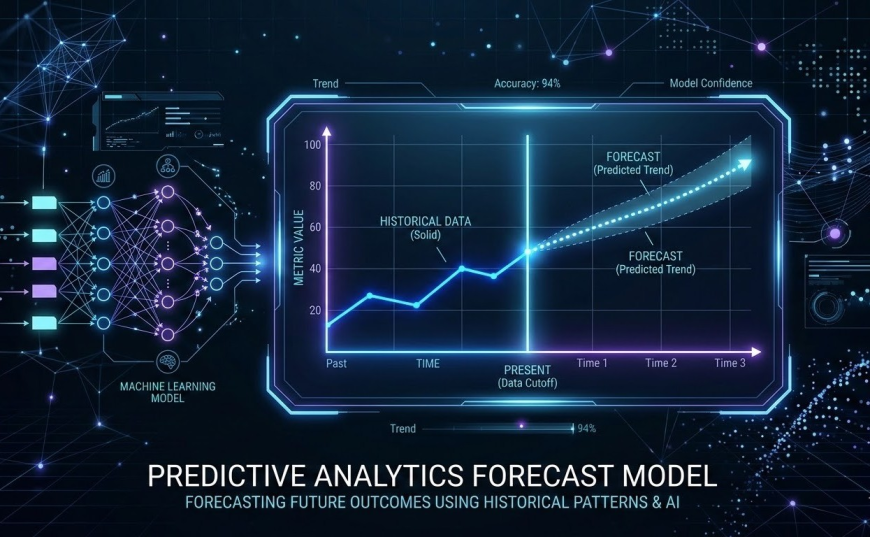
Predictive analytics focuses on forecasting future outcomes based on historical data and statistical models.
It answers the question:
What is likely to happen in the future?
Predictive analytics uses advanced techniques such as machine learning algorithms, statistical modeling, and data mining to analyze patterns and predict future events.
This type of analytics is widely used in industries such as finance, marketing, ecommerce, healthcare, and supply chain management.
Examples of Predictive Analytics
Forecasting future product demand based on past sales trends.
Predicting which customers are likely to stop using a service.
Estimating the probability of loan default in banking systems.
Forecasting website traffic for upcoming marketing campaigns.
For example, an ecommerce company may use predictive analytics to estimate how many units of a product will sell during the next holiday season.
At Neody IT, predictive models are often integrated into business applications to help companies plan inventory, marketing budgets, and customer engagement strategies.
Technologies Used in Predictive Analytics
Predictive analytics typically involves more advanced technologies than descriptive or diagnostic analytics.
Some common technologies include:
Python for machine learning
R for statistical analysis
TensorFlow and Scikit learn
Predictive modeling algorithms
Artificial intelligence systems
These technologies analyze historical data patterns to estimate future probabilities.
Why Predictive Analytics Is Important
Predictive analytics allows organizations to move from reactive decision making to proactive planning.
Key advantages include:
Improved demand forecasting
Better risk management
Personalized marketing strategies
More efficient resource planning
However, predictions alone are not enough. Businesses also need recommendations on what actions they should take based on those predictions. This leads to the most advanced type of analytics.
4. Prescriptive Analytics
What is Prescriptive Analytics?
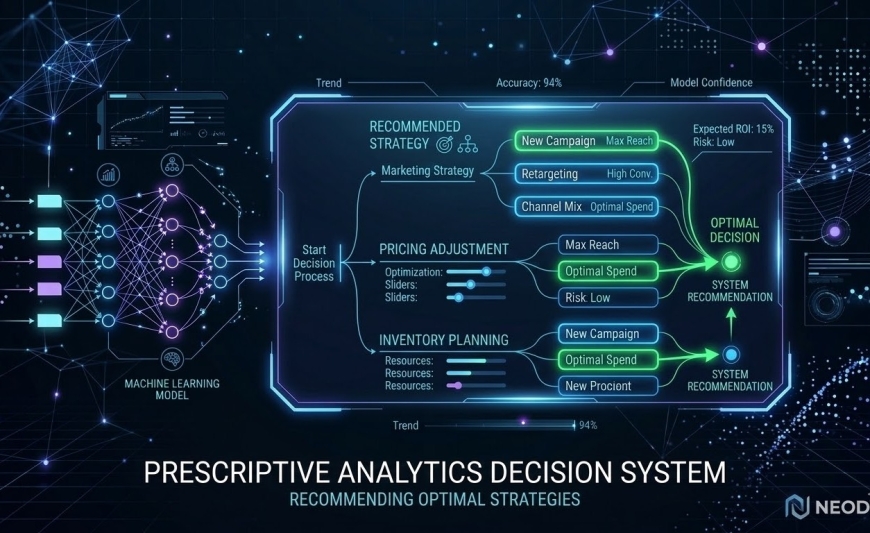
Prescriptive analytics is the most advanced form of data analytics. It goes beyond predicting future outcomes and suggests the best actions to achieve desired results.
In simple words, prescriptive analytics answers the question:
What should we do next?
It combines data analytics, artificial intelligence, optimization algorithms, and business rules to recommend decisions.
Examples of Prescriptive Analytics
Recommending the best marketing strategy for a product launch.
Suggesting the optimal price for a product to maximize profit.
Recommending delivery routes to minimize logistics costs.
Advising which customers should receive promotional offers.
For example, if predictive analytics forecasts high demand for a product, prescriptive analytics might suggest increasing inventory levels and adjusting advertising strategies.
At Neody IT, prescriptive analytics solutions are often integrated into enterprise software to help businesses automate complex decision making processes.
Technologies Used in Prescriptive Analytics
Prescriptive analytics relies on advanced technologies such as:
Artificial intelligence systems
Optimization algorithms
Machine learning models
Decision support systems
Simulation modeling
These technologies help businesses determine the best possible course of action based on data insights.
Why Prescriptive Analytics Is Powerful
Prescriptive analytics enables organizations to automate decision making and optimize outcomes.
Major benefits include:
Data driven strategic planning
Automated recommendations
Optimized resource allocation
Competitive business advantage
Companies that implement prescriptive analytics effectively often gain a significant advantage over competitors.
How the Four Types of Data Analytics Work Together
Although these four analytics types are different, they are closely connected and usually used together.
Descriptive analytics explains what happened.
Diagnostic analytics explains why it happened.
Predictive analytics forecasts what might happen next.
Prescriptive analytics recommends what actions should be taken.
For example, imagine a retail company analyzing its sales performance.
Descriptive analytics shows that sales dropped last quarter.
Diagnostic analytics reveals that the drop happened because online traffic decreased.
Predictive analytics forecasts that sales may continue to decline if the trend continues.
Prescriptive analytics recommends increasing digital marketing efforts and offering promotional discounts.
This complete analytics approach allows businesses to make smarter and more strategic decisions.
How Businesses Use Data Analytics Today
In today's digital economy, almost every organization relies on analytics to drive growth.
Companies use data analytics for:
Customer behavior analysis
Marketing performance optimization
Financial forecasting
Operational efficiency
Product development insights
At Neody IT, we help organizations implement modern analytics solutions including dashboards, data pipelines, predictive models, and AI driven insights that transform raw data into meaningful business intelligence.
As data continues to grow, companies that leverage analytics effectively will have a significant competitive advantage.
Final Thoughts
Data analytics has become a critical capability for businesses that want to stay competitive in a data driven world.
Understanding the four types of data analytics is the first step toward building intelligent systems that support better decision making.
Descriptive analytics helps businesses understand past performance.
Diagnostic analytics uncovers the reasons behind events.
Predictive analytics forecasts future possibilities.
Prescriptive analytics recommends the best actions.
Together, these analytics approaches help organizations move from simple reporting to advanced data driven strategy.
If businesses want to fully unlock the potential of their data, they must gradually adopt all four types of analytics.
At Neody IT, we focus on helping organizations design and implement scalable analytics solutions that convert complex data into practical insights and measurable growth.
As the world becomes increasingly data driven, mastering data analytics will be one of the most valuable skills and capabilities for both businesses and technology professionals.
What's Your Reaction?
 Like
15
Like
15
 Dislike
1
Dislike
1
 Love
5
Love
5
 Funny
0
Funny
0
 Angry
0
Angry
0
 Sad
2
Sad
2
 Wow
5
Wow
5

-
 Leena RaikwarI want to learn the basics of DATA ANALYSIS
 -
Vishal ChauhanGood