






AI vs Machine Learning vs Data Science Explained (Beginner Guide)
Learn the difference between AI, Machine Learning, and Data Science with real examples. A beginner friendly guide by Neody IT to help you choose the right career path.
AI vs Machine Learning vs Data Science: The Complete Beginner Guide (2026)
Artificial Intelligence, Machine Learning, and Data Science are among the most searched technology terms today. If you are a beginner exploring careers in AI, ML, or Data Science, you have probably noticed that these terms are often used interchangeably.
Many online courses mix them together. YouTube tutorials blur the boundaries. Job descriptions combine them into a single role.
As a result, beginners often feel confused about where to start.
At Neody IT, we regularly interact with students, developers, and aspiring AI engineers who ask the same question:
What is the difference between AI, Machine Learning, and Data Science?
This article will give you a clear and practical explanation using real-world examples, simple definitions, and a beginner-friendly roadmap so you can confidently choose the right path.
This guide is written especially for beginners who want to start a career in Artificial Intelligence, Machine Learning, or Data Science.
Why AI, ML and Data Science Confuse Beginners
The Common Confusion
One of the biggest reasons beginners struggle to understand AI, ML, and Data Science is the way these terms are used in the tech industry.
Many people use these terms interchangeably, even though they represent different concepts.
For example, a course might advertise itself as a Data Science course, but most of the syllabus is actually Machine Learning.
Similarly, a job posting might say AI Engineer, but the work mostly involves training Machine Learning models.
Because of this overlap, beginners often feel lost.
They start learning random topics without understanding the bigger picture.
This confusion can slow down progress and make the learning journey frustrating.
At Neody IT, we always recommend understanding the core difference before choosing a roadmap.
Why Understanding the Difference Matters
Understanding the difference between AI, Machine Learning, and Data Science helps you in several ways.
First, it helps you choose the right career path. Each field requires slightly different skills.
Second, it helps you avoid wasting time learning irrelevant topics.
Third, it gives you clarity before starting your learning roadmap.
When beginners understand the relationship between these fields, their learning becomes faster, more focused, and more effective.
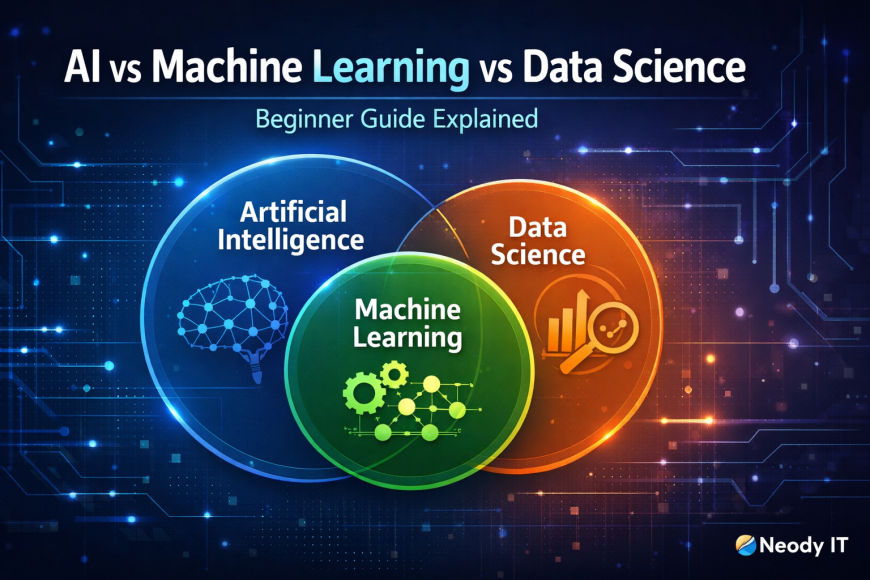
The Big Picture: How AI, ML and Data Science Are Connected
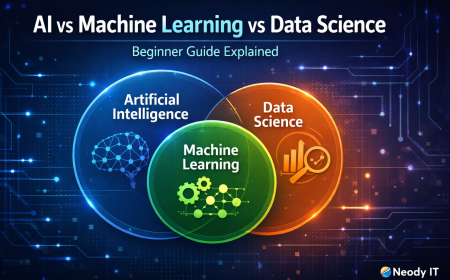
Before diving into individual definitions, it is important to understand the relationship between these fields.
Think of them as overlapping areas in the world of modern technology.
Artificial Intelligence Is the Larger Goal
Artificial Intelligence is the broad field that focuses on building machines capable of performing tasks that normally require human intelligence.
These tasks may include decision making, reasoning, understanding language, or recognizing patterns.
In simple terms, AI is the ultimate goal of making machines intelligent.
Machine Learning Is a Subset of AI
Machine Learning is one of the most important techniques used to achieve Artificial Intelligence.
Instead of programming every rule manually, Machine Learning allows computers to learn patterns from data.
So we can say that:
Machine Learning is a method used to build AI systems.
Data Science Overlaps but Has a Different Focus
Data Science focuses on analyzing data to extract meaningful insights.
While Machine Learning is often used in Data Science, the main goal of Data Science is understanding data and supporting decision making.
So the relationship can be understood as:
AI contains Machine Learning
Data Science overlaps with both AI and ML
This simple understanding removes a lot of confusion.
What Is Artificial Intelligence (AI)?
Definition in Simple Terms
Artificial Intelligence refers to building computer systems that can perform tasks that normally require human intelligence.
These tasks may include decision making, planning, language understanding, and visual recognition.
In simple words, AI is about making machines think and act intelligently.
Goal of Artificial Intelligence
The main goal of AI is to create systems that can:
Automate complex tasks
Make intelligent decisions
Improve efficiency in real-world processes
AI is used in industries ranging from healthcare and finance to transportation and cybersecurity.
At Neody IT, we frequently integrate AI systems into modern applications such as intelligent automation tools and smart digital platforms.
Real World Examples of AI
Artificial Intelligence is already part of everyday life.
Self-driving cars use AI to understand the road and avoid obstacles.
Chatbots use AI to answer customer questions.
Smart assistants like voice-based systems can understand commands and perform tasks.
Fraud detection systems in banking also rely on AI to identify suspicious transactions.
Skills Needed for AI
Building AI systems requires a combination of skills including:
Strong problem-solving ability
Understanding algorithms and data structures
Mathematical reasoning
Logical system design
Advanced AI roles may also require knowledge of deep learning, robotics, and natural language processing.
What Is Machine Learning (ML)?
Definition in Simple Terms
Machine Learning is a branch of Artificial Intelligence that allows computers to learn from data without being explicitly programmed.
Instead of writing thousands of rules, developers train models using datasets so the system can identify patterns.
In simple terms, Machine Learning teaches machines to learn from data.
Goal of Machine Learning
The main goal of Machine Learning is to enable systems to:
Recognize patterns
Make predictions
Automate decisions using data
This is why Machine Learning has become one of the most important technologies in modern software systems.
At Neody IT, Machine Learning models are often used to build predictive systems, recommendation engines, and intelligent analytics platforms.
Real World Examples of Machine Learning
Machine Learning powers many services that people use daily.
Online shopping platforms recommend products based on past behavior.
Email systems detect spam automatically.
Ride-sharing platforms predict travel time and pricing.
Financial systems use ML to detect fraud patterns.
Core Areas in Machine Learning
Machine Learning includes several important techniques.
Regression is used to predict numerical values such as house prices.
Classification is used to categorize data such as spam versus non-spam emails.
Clustering is used to group similar data points together.
Understanding these core concepts is essential for anyone entering the ML field.
What Is Data Science?
Definition in Simple Terms
Data Science is the field that focuses on analyzing large amounts of data to extract meaningful insights.
Instead of building intelligent systems, the primary focus is understanding what the data reveals.
In simple words, Data Science transforms raw data into useful insights.
Goal of Data Science
The main goal of Data Science is to help organizations make better decisions using data.
Data scientists analyze patterns, identify trends, and create reports that guide business strategies.
At Neody IT, data-driven insights play a key role in building smart applications, optimizing systems, and improving product performance.
Real World Examples of Data Science
Many businesses rely heavily on Data Science.
Companies analyze sales data to understand which products perform best.
Streaming platforms study viewer behavior to recommend content.
Marketing teams analyze customer behavior to improve campaigns.
Financial institutions use data analysis to forecast market trends.
Core Skills in Data Science
Data Science requires a strong mix of technical and analytical skills.
Important skills include:
Data cleaning and preprocessing
Exploratory Data Analysis
Statistical analysis
Data visualization tools
Tools like Python, Pandas, and visualization platforms help data scientists turn raw data into clear insights.
AI vs Machine Learning vs Data Science: Side by Side Comparison
Understanding the differences becomes easier when we compare these fields directly.
Based on Purpose
Artificial Intelligence focuses on building intelligent systems capable of making decisions.
Machine Learning focuses on enabling systems to learn patterns from data.
Data Science focuses on extracting insights from data to support business decisions.
Based on Output
AI systems produce intelligent decision-making systems.
Machine Learning models produce predictions.
Data Science produces insights, reports, and analytical understanding.
Based on Tools
Artificial Intelligence uses algorithms, logical models, and Machine Learning techniques.
Machine Learning uses tools such as TensorFlow, Scikit Learn, and PyTorch.
Data Science commonly uses Python, Pandas, visualization tools, and analytics platforms.
Each field overlaps with the others, but their primary objectives are different.
How to Choose Between AI, ML and Data Science
Many beginners ask which field they should choose.
The answer depends on your interests.
Choose Machine Learning If
You enjoy solving prediction problems.
You like building and training models.
You want to work with algorithms that learn from data.
Machine Learning is ideal for people who enjoy mathematical thinking and model optimization.
Choose Data Science If
You enjoy analyzing datasets.
You like discovering trends and patterns.
You enjoy visualizing data and creating reports.
Data Science is a strong choice for people who enjoy business insights and analytical thinking.
Choose Artificial Intelligence If
You want to build intelligent systems.
You are interested in automation, robotics, or advanced intelligent applications.
AI often involves combining multiple technologies including Machine Learning, computer vision, and natural language processing.
At Neody IT, developers working on intelligent applications often combine skills from all three areas.
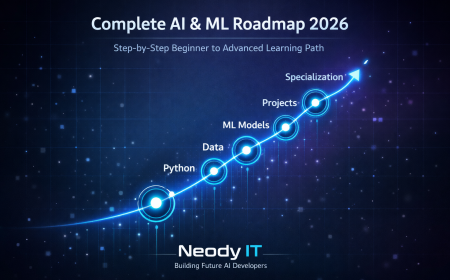
Beginner Roadmap: Where to Start
If you are starting from zero, the best approach is to follow a structured learning roadmap.
Step 1: Learn Python
Python is the most widely used programming language in AI, Machine Learning, and Data Science.
It has powerful libraries that simplify complex tasks.
Step 2: Learn Data Handling
Before building models, you must learn how to handle data.
Libraries like Pandas and NumPy are essential for data manipulation.
Step 3: Choose ML or Data Science Path
After learning Python basics and data handling, choose a specialization.
You can focus on Machine Learning models or Data Science analysis.
Both paths share foundational skills.
Step 4: Build Small Projects
Projects are the best way to learn.
Try building systems like:
Spam detection models
Sales prediction systems
Customer analysis dashboards
Practical work builds real skills.
Step 5: Move to Advanced AI Concepts
Once you understand Machine Learning and data analysis, you can move into advanced AI topics such as:
Deep learning
Natural language processing
Computer vision
These advanced areas power modern AI systems.
At Neody IT, real-world projects often combine these technologies to build intelligent and scalable digital products.
Final Thoughts
Artificial Intelligence, Machine Learning, and Data Science are closely connected but serve different purposes.
Artificial Intelligence focuses on creating intelligent systems.
Machine Learning focuses on enabling systems to learn from data.
Data Science focuses on extracting insights from data.
For beginners, the best approach is to start with Python, understand data, explore Machine Learning basics, and gradually move toward advanced AI systems.
The field is growing rapidly, and the demand for skilled professionals continues to rise globally.
If you want to build real-world AI projects, learn practical technologies, and stay updated with modern development practices, keep following the Neody IT Tech Blog.
At Neody IT, we regularly publish beginner-friendly guides, practical development tutorials, and real-world technology insights to help developers grow faster in the evolving world of AI and modern software development.
What's Your Reaction?
 Like
0
Like
0
 Dislike
0
Dislike
0
 Love
0
Love
0
 Funny
0
Funny
0
 Angry
0
Angry
0
 Sad
0
Sad
0
 Wow
0
Wow
0