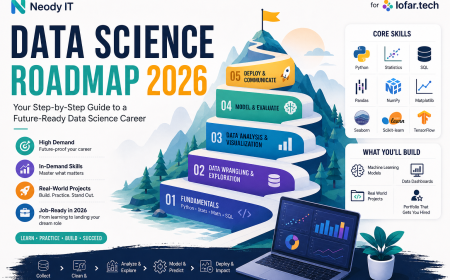








Data Science Roadmap 2026: Step-by-Step Guide
Data Science Roadmap 2026: Learn the exact skills, tools, and steps to become a data scientist. Master Python, SQL, ML, deep learning, projects, and portfolio building.
-
Introduction
-
What a data scientist does in 2026 and how the role is evolving from just “building models” to owning end-to-end business impact.
-
Why data science is still a high-demand, high-impact career in 2026 across finance, e-commerce, healthcare, SaaS, and startups.
-
Who this roadmap is for: complete beginners, data analysts moving up, software engineers switching into ML.
Step 0: Understand the Data Science Role
-
Difference between data analyst, data scientist, and ML engineer (focus, depth of modeling, and ownership of experiments).
-
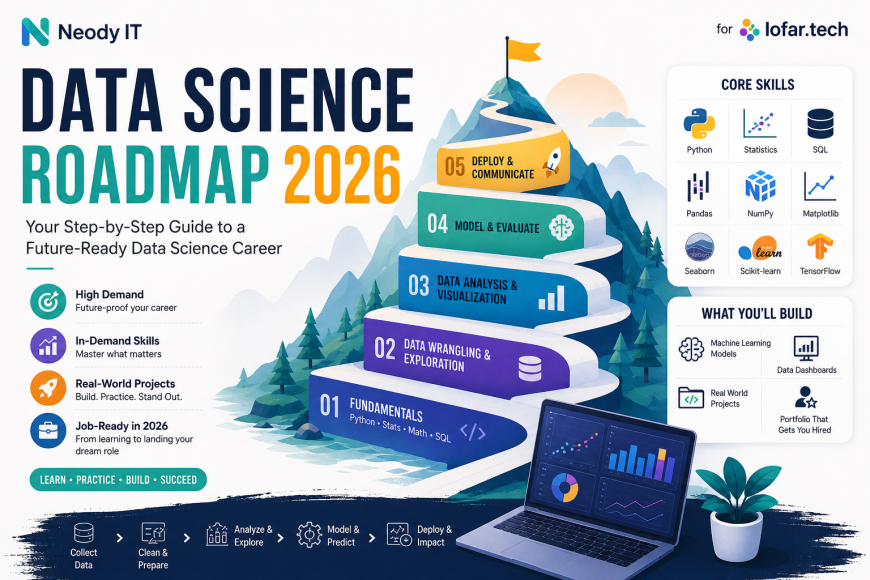
Typical workflow: problem framing, data collection, cleaning, EDA, modeling, evaluation, deployment, monitoring.
-
Core expectation in 2026: not just model accuracy, but business impact, clarity, and the ability to work with AI tools responsibly.
Also Read → Why Resume Not Shortlisted 2026: 8 Fixes
Step 1: Programming Foundations (Python + Basic SQL)
-
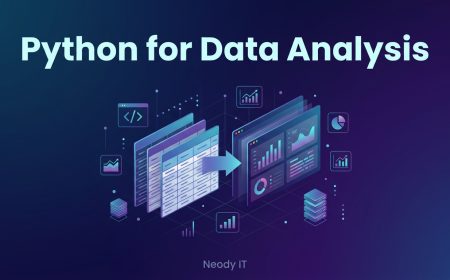
Learn Python basics: variables, data types, lists, dictionaries, loops, functions, error handling.
-
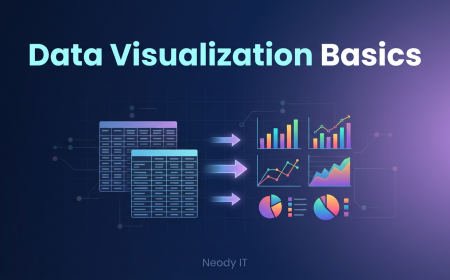
Start using core libraries for data work: Pandas, NumPy, and basic plotting with Matplotlib/Seaborn.
-
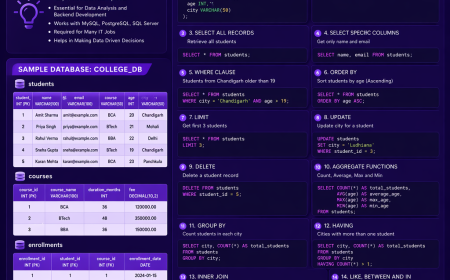
Learn basic SQL: SELECT, WHERE, ORDER BY, GROUP BY, simple joins to pull data from relational databases.
-
Practice by cleaning and analyzing small CSV datasets and simple database tables.
Step 2: Math and Statistics for Data Science
-
Refresh core math: linear algebra (vectors, matrices, dot product), basic calculus (derivatives, gradients) at an intuitive level.
-
Statistics and probability: distributions, mean, variance, standard deviation, confidence intervals, hypothesis testing, p-values.
-
Regression basics: linear regression, loss functions, overfitting vs underfitting, regularization concepts.
-
Use Python to run simple experiments that connect formulas to real data.
Step 3: Data Analysis and Exploratory Data Analysis (EDA)
-
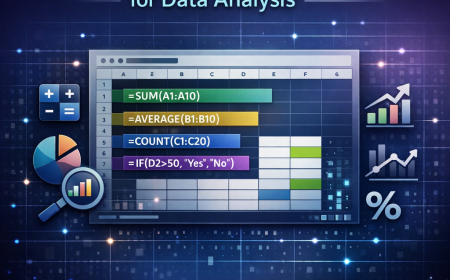
Learn how to clean, wrangle, and reshape datasets with Pandas (missing values, duplicates, encoding categories, scaling).
-
Develop EDA habits: distribution plots, correlation checks, feature importance previews, anomaly spotting.
-
Create readable visualizations to communicate findings to non-technical stakeholders.
-
Practice answering business questions like “What drives churn?” or “Which features best predict conversion?”
Step 4: Core Machine Learning
-
Supervised learning: regression (linear, ridge, lasso), classification (logistic regression, decision trees, random forests, gradient boosting).
-
Unsupervised learning: clustering (K-means), dimensionality reduction (PCA) and when to use them.
-
Model evaluation: train/test split, cross-validation, metrics for regression (RMSE, MAE) and classification (accuracy, precision, recall, F1, ROC AUC).
-
Learn to use scikit-learn pipelines, feature preprocessing, and hyperparameter tuning.
Step 5: Deep Learning and Modern AI (Optional but Powerful)
-
Understand where deep learning is actually needed (images, text, audio, complex patterns) versus where classic ML is enough.
-
Basics of neural networks: layers, activation functions, loss, backpropagation at a conceptual level.
-
Frameworks: intro to TensorFlow or PyTorch for simple models (image classification, sentiment analysis).
-
Explore modern AI tooling (pretrained models, APIs, AutoML) and how to evaluate them instead of blindly relying on them.
Step 6: Data Engineering and MLOps Basics
-
Learn how data gets from source to model: ETL/ELT, data pipelines, batch vs streaming.
-
Basics of working with big data: familiarity with Spark or cloud-native tools (e.g., BigQuery, Snowflake) is a plus.
-
Version control with Git, environment management, and reproducible notebooks.
-
Introduction to MLOps concepts: model deployment options, monitoring drift, retraining cycles.
Step 7: Business and Product Thinking for Data Scientists
-
Problem framing: turning vague requests like “improve retention” into clear data science problems with measurable success metrics.
-
Understanding domain metrics for your target industry (e-commerce, fintech, SaaS, healthcare).
-
Communicating trade-offs: accuracy vs interpretability, model complexity vs deployment cost.
-
Presenting results as product decisions, not just as charts and model reports.
Step 8: Build Real Data Science Projects
Aim for end-to-end projects that cover data, modeling, and decision impact:
-
Churn prediction model with EDA, feature engineering, model comparison, and business recommendations.
-
Demand forecasting for a retail or inventory dataset.
-
Recommendation system for products, content, or courses.
-
NLP project: sentiment analysis or topic modeling on reviews or social media text.
-
One project that integrates external data sources or simple APIs.
Each project should show:
-
Problem statement and business context.
-
Data collection and cleaning.
-
Modeling approach and evaluation.
-
Insights and recommendations (what should the business do next).
Step 9: Portfolio, GitHub, and Writing
-
Create a clean GitHub profile with well-structured repositories and clear README files.
-
Host a simple portfolio (Notion, GitHub Pages, or personal site) highlighting 3–6 strong projects and their impact.
-
Write short case-study style blog posts or notebooks explaining your thinking, not just code.
-
Optionally include experiments with tools like notebooks plus dashboards (Streamlit, Gradio) to demo models.
Step 10: Interview Preparation and Job Strategy
-
Review data science fundamentals: probability, ML algorithms, evaluation metrics, bias/variance, feature engineering.
-
Practice coding interviews focused on Python, SQL, and data manipulation.
-
Solve case-style questions: “How would you design an experiment for…?” “How would you improve this model?”
-
Prepare a clear narrative: your background, why data science, your strongest project, and your long-term direction.
-
Target roles: data scientist, applied scientist, ML engineer (junior), decision scientist, or advanced data analyst roles.
-
What's Your Reaction?
 Like
5
Like
5
 Dislike
1
Dislike
1
 Love
0
Love
0
 Funny
0
Funny
0
 Angry
0
Angry
0
 Sad
0
Sad
0
 Wow
2
Wow
2