











Why Java Still Rules Enterprise Development in 2026
In 2026, Java remains the backbone of enterprise systems. Learn how JVM, Spring Boot, GraalVM, and banking-grade reliability keep Java dominant insights from Neody IT.
Introduction
In 2026, enterprises face growing complexity: microservices, cloud-native platforms, strict compliance, and the need for high-throughput, low-latency systems. Amidst newer languages and frameworks, Java remains the default choice for mission-critical backend systems. For Neody IT and many engineering teams worldwide, Java’s ecosystem, performance characteristics, and institutional momentum keep it central to enterprise architecture. This article explains why Java still dominates enterprise development in 2026, covering scalability, Spring Boot, banking systems, Android legacy influences, and backend ecosystem depth plus practical examples and small code snippets.
A short history: Java’s enterprise journey
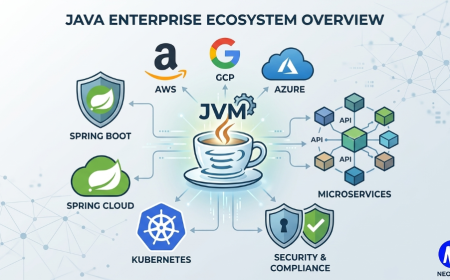
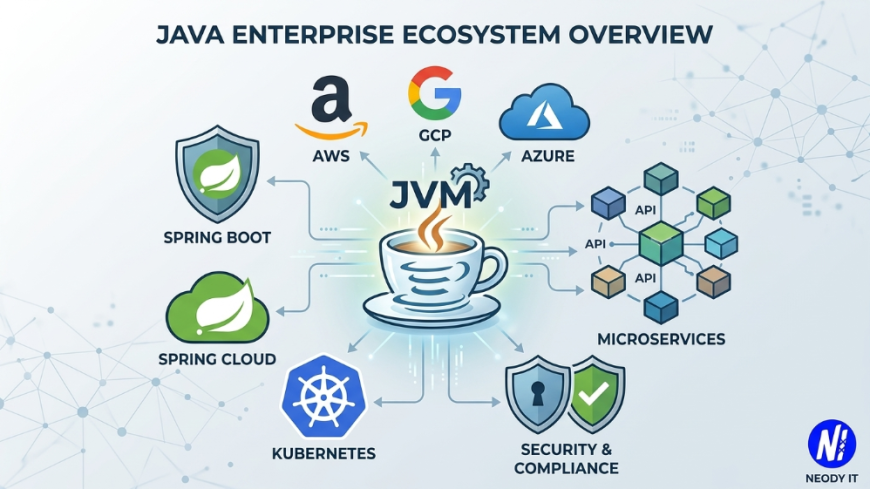
Java’s enterprise presence started in the late 1990s with the JVM, J2EE (now Jakarta EE), and decades of investment in middleware and tooling. Key milestones shaped its longevity:
-
JVM: A battle-tested runtime offering cross-platform portability and mature JIT optimizations.
-
Jakarta EE and Java EE: Enterprise APIs for transactions, messaging, and security.
-
Spring and Spring Boot: Delivered developer productivity and a path to microservices.
-
Microservices era: Java frameworks adapted with Spring Cloud, reactive stacks, and support for containers and orchestration.
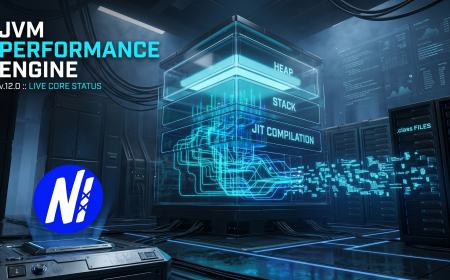
Also Read → How JVM Works Internally? Bytecode, Memory & GC
Java has evolved with features like the module system, steadily shorter release cadence, records, and support for GraalVM native images all helping it stay relevant.
Enterprise priorities that favor Java :
Enterprises choose technologies that minimize risk and maximize predictability. Java aligns with these priorities:
-
Reliability and predictability: LTS releases and stable release cycles reduce disruption for long-lived systems.
-
Backward compatibility: The JVM and Java language emphasize compatibility, making upgrades less risky.
-
Security and governance: Java’s libraries, mature security tooling, and enterprise support satisfy compliance needs.
-
Talent and hiring: A large pool of experienced Java engineers, plus numerous certification and training options.
Scalability and performance :
Java’s runtime and ecosystem enable both vertical and horizontal scaling:
-
JVM strengths: Just-in-time (JIT) compilation and adaptive optimizations allow Java apps to reach high throughput while the JVM optimizes hotspots at runtime.
-
Horizontal vs. vertical scaling: Java services are commonly containerized and scaled horizontally in Kubernetes, while JVM improvements mean fewer resources wasted per instance.
-
Modern GC and memory: ZGC and Shenandoah provide low-pause garbage collection for large heaps, reducing tail latency for services with large memory footprints.
-
Concurrency: Java provides mature concurrency primitives and libraries. With Project Loom (continuations/virtual threads), concurrency models simplify while reducing context-switch overhead.
Real-world example: An e-commerce checkout service at scale
A typical e-commerce checkout in production handles bursty traffic during sales. Using Spring Boot with connection pools, async processing, and tuned GC, teams can achieve predictable latency at high throughput. Companies often use horizontal scaling in Kubernetes, autoscaling based on CPU and custom latency SLOs, and caching layers for repeated reads patterns Neody IT implements for clients.
The Spring ecosystem and developer productivity
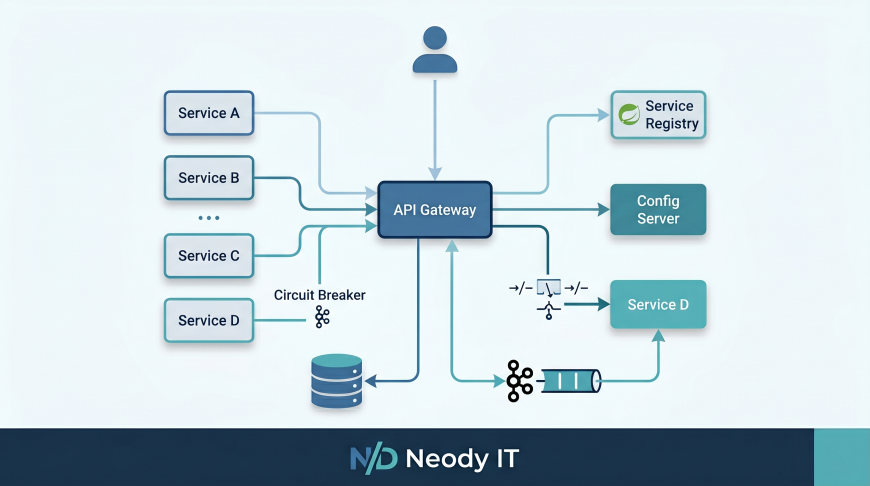
Spring’s contributions to Java’s dominance are enormous, especially Spring Boot:
-
Spring Boot: Convention over configuration, starters, and embedded servers let teams bootstrap microservices quickly.
-
Spring Cloud: Provides common distributed-system patterns: config management, service discovery, circuit breakers, and distributed tracing integrations.
-
Maturity: Starters, auto-configuration, and built-in testing support (Spring Test, MockMvc) speed development.
-
Developer velocity: Rich IDE support, Spring Initializr, and extensive docs reduce onboarding time.
Code snippet: Minimal Spring Boot REST service
package com.neodyit.demo;import org.springframework.boot.SpringApplication;import org.springframework.boot.autoconfigure.SpringBootApplication;import org.springframework.web.bind.annotation.GetMapping;import org.springframework.web.bind.annotation.RestController;@SpringBootApplicationpublic class DemoApplication {public static void main(String[] args) {SpringApplication.run(DemoApplication.class, args);}}@RestControllerclass HealthController {@GetMapping("/health")public String health() {return "OK";}}
Productivity vs. performance tradeoffs :
Spring Boot favors productivity; however, large monolithic bootstrapped services can have heavier footprints. Mitigations include using GraalVM native images for smaller binaries or modularizing services and using Spring Native to reduce startup times for serverless and low-latency use cases.
Banking, finance, and regulated industries:
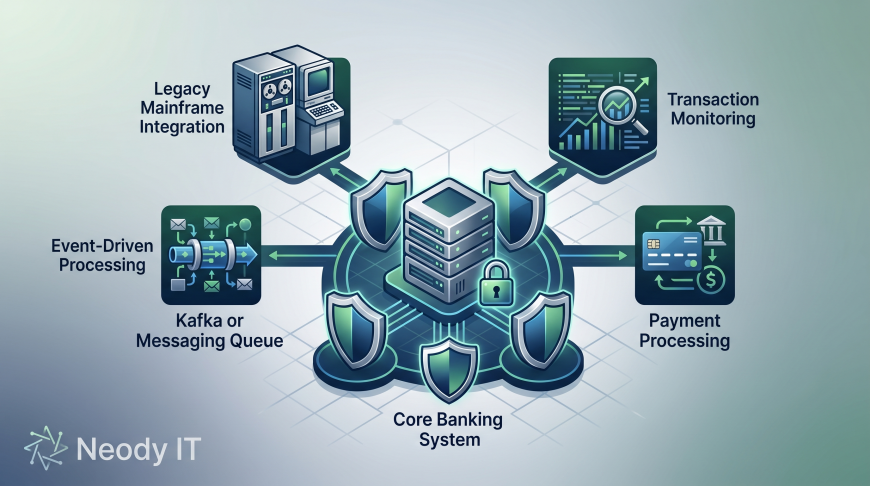
Banks and regulated enterprises continue to rely on Java for several reasons:
-
Risk minimization: Financial systems prioritize stability and auditability over novelty.
-
Transactional integrity: JVM middleware supports JMS, JTA, and mature transaction managers to maintain ACID guarantees.
-
Legacy integration: Java-based connectors and adapters facilitate interaction with mainframes and message brokers (IBM MQ, Kafka).
-
SLAs and compliance: Proven Java platforms meet strict uptime and regulatory requirements.
Case study points (non-identifying): In payments clearing and trade processing, Java services often manage core transaction flow, reconciliation jobs, and batch-processing pipelines. Their robustness and observability make them preferable for mission-critical functions.
Android legacy and mobile influence:
Android’s historical use of Java (and current Kotlin interoperability) affects enterprise choices:
-
Mobile-backend consistency: Many enterprises maintain Java-based backends to align with Android mobile teams and reuse libraries and DTOs.
-
Kotlin coexistence: Kotlin runs on the JVM, allowing mixed-language projects while preserving Java’s ecosystem advantages.
-
Shared contracts: gRPC and protobuf contracts between mobile and backend encourage stable, versioned communication often implemented on Java servers.
Backend dominance and ecosystem depth:
Java’s rich ecosystem supports complete enterprise needs:
-
Libraries and frameworks: Observability (Micrometer), security (Spring Security), data access (JPA, Hibernate), streaming (Kafka clients).
-
DevOps integration: Maven and Gradle pipelines are battle-tested, and official OpenJDK images and optimized container images exist for mainstream clouds.
-
Observability and ops: Production-grade tooling with integration to Prometheus, Grafana, and tracing systems (OpenTelemetry) simplifies SRE workflows.
-
Vendor and cloud support: AWS, GCP, and Azure provide first-class Java runtimes and managed services tailored to Java applications.
Modern adaptations keeping Java relevant :
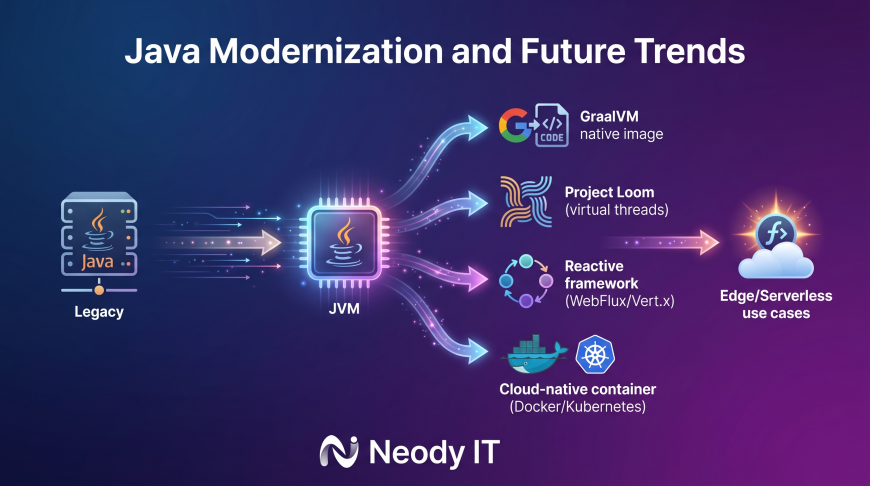
Java isn’t stagnant; recent innovations matter in 2026:
-
GraalVM and native images: Reduce startup time and binary size for serverless and edge use cases.
-
Reactive frameworks: Spring WebFlux, Vert.x, and RSocket offer non-blocking architectures for high-concurrency workloads.
-
Project Loom: Virtual threads simplify concurrent programming without sacrificing throughput.
-
Polyglot JVM: Kotlin, Scala, and Clojure coexist on the JVM, allowing teams to pick languages while retaining JVM benefits.
When Java might not be the best choice:
Java is not always the optimal tool:
-
Rapid scripting or small utilities: Languages like Python or Node.js can be faster for prototyping.
-
Extreme low-latency systems: C++ or Rust may be preferable where microsecond latency and fine-grained memory control matter.
-
Teams favoring functional-first paradigms: If a team prioritizes a pure functional language, alternatives may suit specific domains better.
Migration and coexistence strategies:
Enterprises rarely rewrite everything. Practical strategies include:
-
Strangler pattern: Incrementally replace legacy modules behind APIs.
-
gRPC/REST contracts: Language-agnostic service boundaries let teams adopt new languages without big-bang migration.
-
Wrapping legacy logic: Expose Java business logic as services or adaptors to integrate with newer microservices.
Practical advice for enterprise teams in 2026:
-
Choose Java when you need long-term stability, a rich ecosystem, and operational predictability.
-
Use Spring Boot for consistent microservice patterns and faster onboarding.
-
Consider GraalVM and modular builds for serverless functions to optimize cold starts.
-
Invest in observability (OpenTelemetry, Prometheus), GC tuning, connection pooling, and automated testing for production resilience.
-
For Neody IT clients, standardizing CI/CD, monitoring, and secure deployments around Java tooling pays dividends in maintainability and hiring.
Conclusion :
Java’s dominance in enterprise software development in 2026 is not accidental. Its runtime optimizations, mature ecosystem (notably Spring Boot), reliability in regulated domains like banking, continued relevance from Android’s legacy, and deep operational tooling make it the safe, pragmatic choice for many organizations. With advancements like GraalVM, Project Loom, and improved cloud integrations, Java continues to adapt keeping it firmly at the center of enterprise backends.
If Neody IT can help your team evaluate or modernize Java workloads, from Spring Boot microservices to GraalVM native builds and observability pipelines, contact our engineering team to start a practical migration plan or performance audit.
What's Your Reaction?
 Like
0
Like
0
 Dislike
0
Dislike
0
 Love
0
Love
0
 Funny
0
Funny
0
 Angry
0
Angry
0
 Sad
0
Sad
0
 Wow
0
Wow
0