
















Python Functions and Recursion Tutorial
Learn Python functions and recursion with examples, parameters, return values, and real-world use cases in this 2026 guide.
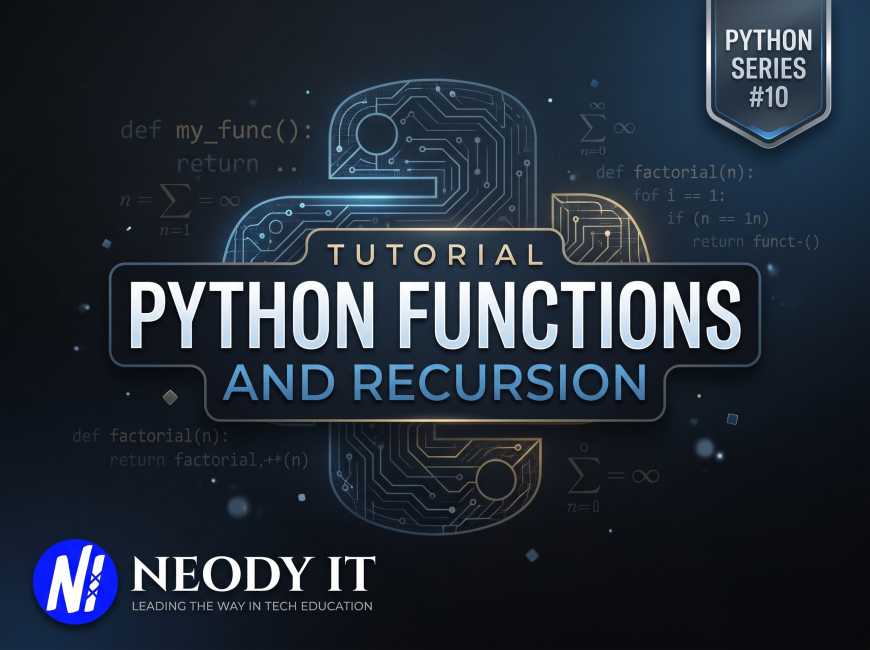
Python Functions and Recursion Explained with Examples (2026 Guide)
Python Series #10
Functions and Recursion are two of the most important concepts in Python programming. They help developers write reusable, organized, and scalable code for modern applications.
From AI systems and backend APIs to automation tools and data processing pipelines, functions are used everywhere in professional software development.
In this beginner-friendly tutorial by Neody IT, you will learn Python Functions and Recursion with syntax, examples, real-world use cases, best practices, debugging tips, and advanced developer insights.
Introduction
Imagine building:
-
A login system
Also Read → Python Conditional Expressions Tutorial -
An AI chatbot
-
A payment gateway
-
A weather application
-
A recommendation engine
-
A backend API
Without functions, developers would need to repeat the same code again and again.
That leads to:
-
Large messy files
-
Difficult debugging
-
Poor scalability
-
Repetitive logic
-
Higher maintenance cost
Functions solve this problem by allowing developers to reuse code efficiently.
Recursion takes this concept further by allowing a function to call itself.
At Neody IT, functions and recursion are heavily used in:
-
AI workflows
-
Backend systems
-
Automation tools
-
Data processing pipelines
-
API handling
-
Algorithm development
If you want to become a strong Python developer in 2026, mastering functions is essential.
What are Functions in Python?
A Function is a reusable block of code that performs a specific task.
Instead of writing the same logic repeatedly, developers can create a function once and use it multiple times.
Why Functions Matter
Functions help developers:
-
Reduce code duplication
-
Improve readability
-
Simplify debugging
-
Build scalable applications
-
Organize projects better
Functions are heavily used in:
-
AI systems
-
Web development
-
APIs
-
Cloud applications
-
Automation scripts
-
Data Science
Prerequisites
Before starting this tutorial, you should know:
-
Variables
-
Loops
-
Conditional statements
-
Basic Python syntax
Tools Required
-
Python 3.12+
-
VS Code or PyCharm
-
Terminal or Command Prompt
Setting Up the Environment
Create a Python file:
functions_recursion.py
Run the file:
python functions_recursion.py
Creating a Function in Python
Functions are created using the def keyword.
Basic Syntax
def greet():
    print("Hello from Neody IT")

greet()
Output
Hello from Neody IT
How Functions Work
-
Function is defined
-
Python stores the function
-
Function executes only when called
Function Parameters
Parameters allow functions to receive data.
def greet(name):
    print(f"Hello, {name}")

greet("Mayank")
Output
Hello, Mayank
Multiple Parameters
def add(a, b):
    print(a + b)

add(10, 20)
Output
30
Return Statement
Functions can return values using return.
def multiply(a, b):
    return a * b

result = multiply(5, 4)

print(result)
Output
20
Why return is Important
return allows:
-
Reusing output
-
Storing results
-
Passing values to other functions
Professional applications rely heavily on returned values.
Default Parameters
Default values prevent errors if arguments are missing.
def greet(name="User"):
    print(f"Hello, {name}")

greet()
greet("Aman")
Output
Hello, User
Hello, Aman
Keyword Arguments
Arguments can be passed using parameter names.
def student(name, age):
    print(name, age)

student(age=21, name="Rahul")
Arbitrary Arguments (*args)
Used when number of arguments is unknown.
def total(*numbers):
    print(sum(numbers))

total(1, 2, 3, 4)
Output
10
Keyword Arbitrary Arguments (**kwargs)
Used for flexible key-value arguments.
def profile(**data):
    print(data)

profile(name="Mayank", role="Developer")
Output
{'name': 'Mayank', 'role': 'Developer'}
Lambda Functions
Small anonymous functions.
square = lambda x: x * x

print(square(5))
Output
25
Scope of Variables
Local Scope
Variables inside function exist only there.
def test():
    message = "Local Variable"
    print(message)

test()
Global Scope
Variables outside functions are global.
name = "Neody IT"

def show():
    print(name)

show()
What is Recursion in Python?
Recursion happens when a function calls itself.
Basic Recursion Example
def countdown(n):
    if n == 0:
        return

    print(n)
    countdown(n - 1)

countdown(5)
Output
5
4
3
2
1
Understanding Base Condition
A recursion must have a stopping condition.
Without it:
-
Infinite recursion occurs
-
Program crashes
The stopping condition is called the Base Condition.
Factorial Using Recursion
A common recursion example.
def factorial(n):
    if n == 1:
        return 1

    return n * factorial(n - 1)

print(factorial(5))
Output
120
Fibonacci Series Using Recursion
def fibonacci(n):
    if n <= 1:
        return n

    return fibonacci(n-1) + fibonacci(n-2)

print(fibonacci(6))
Output
8
Real World Use Cases
Backend Development
Functions are used in:
-
API endpoints
-
Authentication systems
-
Database operations
Example:
def authenticate(username, password):
    return username == "admin" and password == "1234"
AI and Machine Learning
Functions are heavily used for:
-
Model training
-
Data preprocessing
-
Prediction systems
-
AI workflows
Automation Scripts
def send_email(email):
    print(f"Email sent to {email}")
Recursion in Real Projects
Recursion is used in:
-
File system traversal
-
Tree structures
-
AI algorithms
-
Graph processing
-
Search algorithms
At Neody IT, recursion is used in automation systems and advanced backend processing workflows.
Common Errors and Fixes
Missing Arguments
Wrong:
def add(a, b):
    print(a + b)

add(5)
This causes argument error.
Infinite Recursion
Wrong:
def test():
    test()

test()
This crashes the program.
Fix
Always use base condition.
def test(n):
    if n == 0:
        return

    test(n - 1)
Forgetting return Statement
Wrong:
def add(a, b):
    a + b
Correct:
def add(a, b):
    return a + b
Best Practices
Keep Functions Small
One function should solve one problem.
Use Meaningful Function Names
Bad:
def x():
Better:
def calculate_total():
Avoid Excessive Global Variables
Prefer local variables.
Use Recursion Carefully
Recursion can consume more memory.
Sometimes loops are better.
Write Reusable Functions
Good functions work in multiple scenarios.
Advanced Tips
Recursive vs Iterative Approach
Loop version is often faster.
Example:
def factorial_loop(n):
    result = 1

    for i in range(1, n + 1):
        result *= i

    return result
Higher Order Functions
Functions can accept other functions.
def operate(func, value):
    return func(value)

print(operate(lambda x: x*x, 5))
Docstrings
Professional developers document functions.
def greet(name):
    """Greets user"""
    print(f"Hello {name}")
Future Scope and Industry Trends
Functions remain one of the most important concepts in:
-
AI Engineering
-
Backend Development
-
Cloud Computing
-
Automation
-
Cybersecurity
-
Data Science
Modern frameworks and AI systems are built heavily around modular functions.
At Neody IT, functions are used extensively in:
-
AI integrations
-
REST APIs
-
Automation systems
-
Backend architectures
-
Enterprise software
Developers who master functions write:
-
Cleaner code
-
Scalable applications
-
Maintainable systems
-
Better optimized software
Frequently Asked Questions (FAQ)
What is a function in Python?
A function is a reusable block of code designed to perform a specific task.
Why are functions important?
Functions improve:
-
Code reuse
-
Readability
-
Scalability
-
Maintenance
What is recursion in Python?
Recursion happens when a function calls itself.
What is a base condition?
A stopping condition that prevents infinite recursion.
What is the difference between return and print?
print() displays output while return sends value back to caller.
What are lambda functions?
Small anonymous one-line functions.
Where are functions used in real projects?
Functions are used in:
-
APIs
-
AI systems
-
Automation
-
Backend systems
-
Data processing
Final Thoughts
Functions and Recursion are core foundations of Python programming.
In this tutorial, you learned:
-
Creating functions
-
Parameters and return values
-
Lambda functions
-
Variable scope
-
Recursion
-
Base conditions
-
Real-world use cases
-
Best practices
Mastering these concepts will help you build:
-
AI systems
-
Backend APIs
-
Automation workflows
-
Scalable applications
-
Professional Python projects
If you want to become a strong Python developer in 2026, learning functions deeply is essential.
CTA
Explore more Python tutorials, backend development guides, and AI-focused coding content on Neody IT.
Follow Neody IT for practical programming tutorials and modern software engineering insights.
What's Your Reaction?
 Like
0
Like
0
 Dislike
0
Dislike
0
 Love
0
Love
0
 Funny
0
Funny
0
 Angry
0
Angry
0
 Sad
0
Sad
0
 Wow
1
Wow
1