




















Understanding Data: Beginner Guide to Data Types
Learn what data is, the difference between structured and unstructured data, real world examples, and why data is the foundation of data analytics and AI in this beginner guide by Neody IT.
Understanding Data: A Beginner Guide to the Foundation of Data Analytics
In today’s digital world, almost everything we do generates data. Every time you search on Google, watch a video, make an online purchase, or interact on social media, information about that activity is recorded somewhere.
This massive amount of information is what we call data.
Businesses, governments, and technology companies rely heavily on data to understand trends, make better decisions, and build intelligent systems. In fact, modern technologies such as Artificial Intelligence, Machine Learning, and Data Analytics all depend on data to function.
At Neody IT, we often explain to beginners that before learning tools like Python or SQL, it is important to understand the most fundamental concept in the entire field: data itself.
In this guide, you will learn what data actually is, the different types of data, where it comes from, real world examples, and why understanding data is the first step toward building a career in Data Analytics or AI.
Why Data Matters in the Modern World
Data has become one of the most valuable resources in the modern digital economy. Companies use data to understand customer behavior, improve products, optimize marketing strategies, and make smarter business decisions.
Think about how many digital platforms you interact with every day. When you shop online, streaming platforms track what you watch. When you use social media, platforms record likes, comments, and interactions.
All of this information becomes data.
Businesses analyze this data to answer important questions such as:
Which products are selling the most
Which marketing campaign is performing best
What customers are interested in buying next
Without analyzing data, companies would have no reliable way to understand these patterns.
This is why data is often called the raw material of modern technology and decision making.
What is Data
A Simple Definition of Data
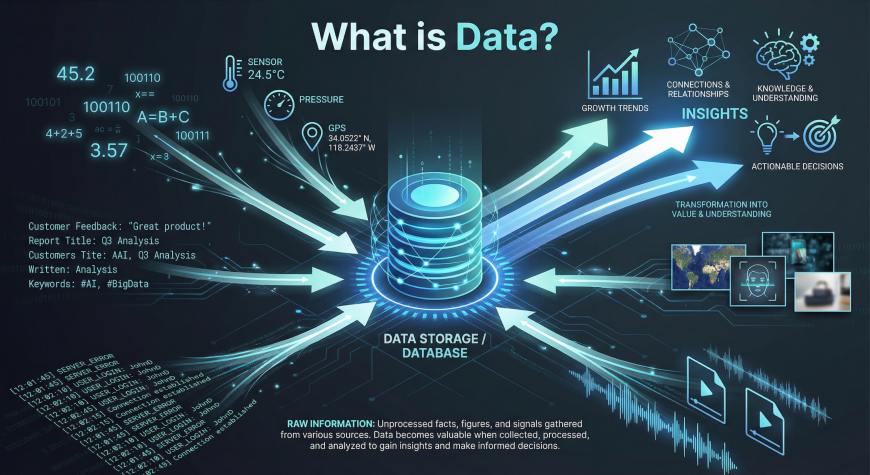
Data can be defined as raw information that can be collected, stored, and analyzed to discover patterns and support decision making.
In its simplest form, data represents facts or observations about something.
Data can appear in many forms, including numbers, text, images, videos, logs, or even sensor readings.
However, raw data by itself does not provide value. It becomes meaningful only when it is organized and analyzed.
For example, a spreadsheet containing thousands of sales numbers is just raw data. When analysts study those numbers to identify trends or patterns, the results become insights that help businesses make decisions.
This transformation from raw information to useful knowledge is the essence of data analysis.
Types of Data
Understanding different types of data is an important concept in Data Analytics. Data can exist in multiple formats depending on how it is stored and organized.
Structured Data
Structured data is the most organized form of data. It is stored in a clearly defined format, usually in rows and columns.
Because it follows a fixed structure, it is easy to search, filter, and analyze.
Examples of structured data include Excel spreadsheets, SQL database tables, customer records, and financial transactions.
Businesses frequently store operational data in structured databases because it allows analysts to retrieve information quickly using tools like SQL.
For instance, a company may store all its customer purchases in a structured database table. Analysts can then query this data to analyze sales performance or customer behavior.
Unstructured Data
Unstructured data is the opposite of structured data. It does not follow a predefined format and cannot be easily organized into rows and columns.
Examples of unstructured data include images, videos, emails, audio recordings, social media posts, and text documents.
Most of the data generated on the internet today falls into this category.
For example, photos uploaded to social media, video content on streaming platforms, and text messages exchanged between users are all forms of unstructured data.
Analyzing unstructured data often requires more advanced techniques such as Natural Language Processing or image recognition.
Semi Structured Data
Semi structured data falls somewhere between structured and unstructured data. It contains some organizational elements but does not follow the strict tabular structure used in databases.
Common examples include JSON files, XML files, and web server logs.
These formats organize data using tags or key value pairs rather than rows and columns.
Semi structured data is commonly used in web applications and APIs where information must be transmitted between systems in a flexible format.
Real World Examples of Data
To better understand data, it helps to look at how it appears in real world scenarios.
Business Data
Companies collect large amounts of data related to their operations.
Examples include sales transactions, customer profiles, and product inventory records.
Businesses analyze this data to identify trends such as best selling products, seasonal demand patterns, and customer purchasing behavior.
These insights help companies improve business strategies and increase profitability.
Internet and Social Media Data
Online platforms collect vast amounts of data from user interactions.
Examples include search queries, likes, comments, and browsing history.
Companies analyze this data to understand user preferences and deliver personalized experiences.
For example, streaming platforms recommend movies based on what you previously watched.
Sensor and Machine Data
Many industries rely on sensors and machines that constantly generate data.
Examples include GPS location data from smartphones, smart device readings from IoT systems, and machine performance logs in manufacturing facilities.
This type of data helps organizations monitor operations, detect problems, and optimize performance.
Structured vs Unstructured Data
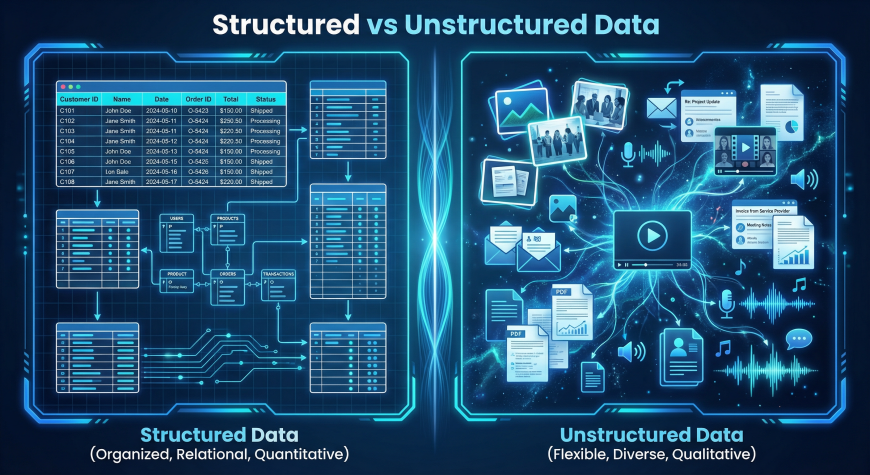
Understanding the difference between structured and unstructured data is essential for anyone entering the field of Data Analytics.
Structured data is organized in tables with rows and columns. It is easy to query and analyze using database tools.
Unstructured data has no fixed format and often includes media content such as images, videos, and text.
While structured data is easier to analyze, unstructured data contains valuable insights about human behavior and digital activity.
Both types of data play an important role in modern analytics systems.
Where Data Comes From
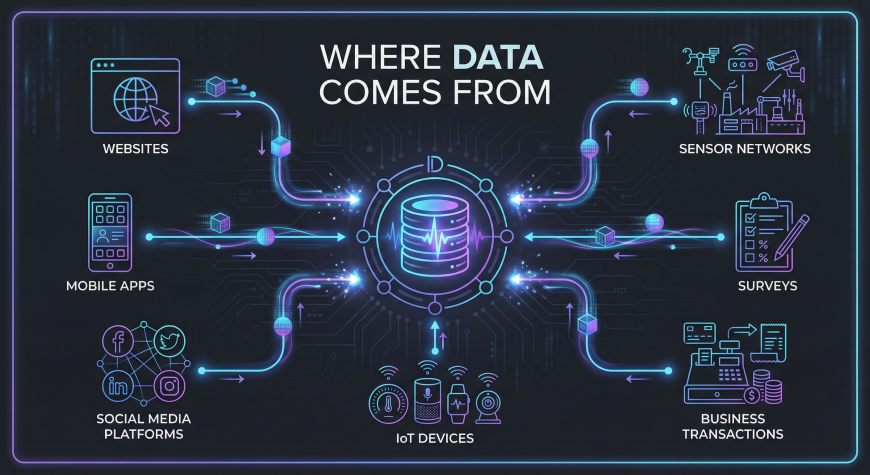
Modern digital systems generate data from many different sources.
Common sources include websites that track user activity, mobile applications that monitor engagement, and business transactions recorded in company databases.
Social media platforms produce massive datasets from user interactions. IoT devices collect data from sensors embedded in machines and devices.
Surveys, online forms, and customer feedback systems also generate useful datasets.
Because of these numerous sources, the amount of global data continues to grow rapidly every year.
Why Understanding Data is Important
For beginners entering the world of Data Analytics or Artificial Intelligence, understanding data is the most important starting point.
Data forms the foundation of analytics systems. Without data, analysts cannot identify patterns or generate insights.
Machine Learning models also rely on data to learn relationships between variables and make predictions.
Businesses use data driven insights to guide decisions related to marketing, product development, and customer experience.
Without understanding what data is and how it is structured, learning analytics tools becomes much more difficult.
At Neody IT, we encourage beginners to first understand data before moving on to tools or machine learning models.
Examples of Structured Datasets
Many datasets used in analytics projects are structured.
Examples include customer purchase records that track buying behavior, student exam result datasets used for performance analysis, and product inventory tables used in retail businesses.
Sales reports are another example of structured data where information is organized by product, region, and time period.
These datasets can easily be analyzed using tools such as Excel, SQL, or Python.
Free Datasets for Practice
One of the best ways to understand data is by working with real datasets.
Kaggle Datasets
Kaggle is one of the most popular platforms for data science learning. It provides thousands of free datasets covering topics such as business analytics, movie ratings, healthcare data, and customer behavior.
Beginners can download these datasets and practice analyzing them using data analytics tools.
Government Open Data
Many governments around the world publish public datasets for research and transparency.
These datasets often include economic indicators, population statistics, transportation data, and environmental information.
Government open data portals are valuable resources for learning data analysis using real world information.
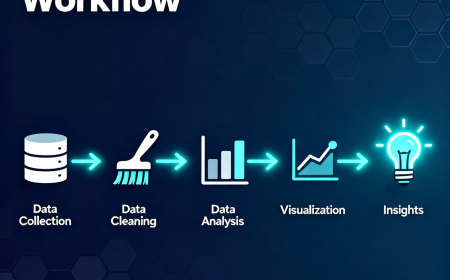
How Data Becomes Insights
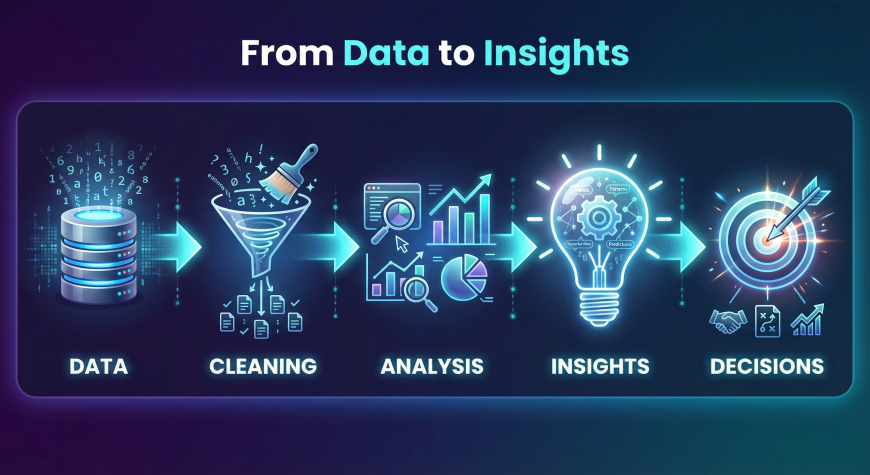
Raw data alone does not provide value. It must go through a process before it becomes useful for decision making.
The process typically follows a simple pipeline.
Data is collected from various sources.
The data is cleaned to remove errors and inconsistencies.
Analysts examine the data to identify patterns and trends.
Insights are generated based on the analysis.
Organizations use those insights to make better decisions.
This transformation from data to insight is the central idea behind Data Analytics.
Final Takeaway
Data is the starting point of every analytics system, artificial intelligence model, and data driven business strategy.
In simple terms, data represents raw information. Analysis helps us understand patterns within that information. Insights are the meaningful conclusions derived from that analysis.
Anyone interested in Data Analytics, Machine Learning, or Artificial Intelligence must first understand what data is and how it is structured.
At Neody IT, we believe building a strong foundation in data concepts is the first step toward mastering the world of analytics and intelligent technologies.
If you want to begin your journey in data, start by exploring datasets, understanding how data is organized, and practicing simple analysis techniques. From there, you can gradually move toward advanced tools and analytics methods that transform data into powerful insights.
What's Your Reaction?
 Like
3
Like
3
 Dislike
0
Dislike
0
 Love
0
Love
0
 Funny
0
Funny
0
 Angry
0
Angry
0
 Sad
0
Sad
0
 Wow
2
Wow
2