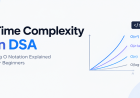























Time Complexity in DSA: Big O Notation Explained for Beginners
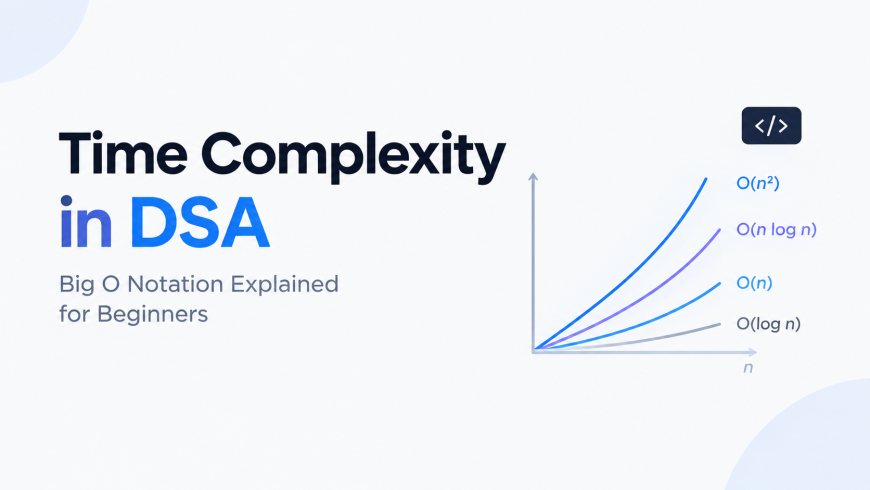
Time Complexity in DSA: Big O Notation Explained for Beginners
Your code gives the correct answer.
It works perfectly on the sample test cases.
So why can it still get rejected in a coding interview?
Because in programming, getting the correct answer is only part of the problem.
A good solution should not only produce the right output. It should also use resources efficiently, especially when the size of the input becomes very large.
This is where Time Complexity comes into the picture.
If you are learning Data Structures and Algorithms (DSA), understanding time complexity and Big O notation is one of the most important fundamentals you should learn before jumping into hundreds of coding problems.
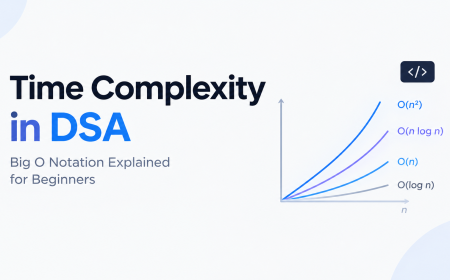
In this guide, we'll understand what time complexity means, why it matters, what Big O notation is, and how to recognize common complexities such as O(1), O(log n), O(n), O(n log n), and O(n²).
What Is Time Complexity?
Time complexity is a way of describing how the running time or number of operations performed by an algorithm grows as the input size increases.
In simple words:
Time complexity tells us how an algorithm scales when the amount of input becomes larger.
Imagine you have an array containing 10 numbers and you want to find a particular number.
If your algorithm checks every number one by one, you may perform up to 10 checks.
Now imagine the array contains 10 lakh numbers.
The same algorithm could potentially perform up to 10 lakh checks.
The actual time taken depends on the programming language, hardware, compiler, and many other factors. That's why, in DSA, we generally focus on how the number of operations grows with input size, rather than measuring the exact time in seconds.
This gives us a machine-independent way to compare algorithms.
Why Is Time Complexity Important in DSA?
A program can be correct and still be inefficient.
Consider two algorithms that solve exactly the same problem.
-
Algorithm A takes roughly 100 operations.
-
Algorithm B takes roughly 10,000 operations.
Both may produce the correct answer.
For a tiny input, you might not notice much difference.
But when the input becomes millions of elements, the difference can become enormous.
This is why interviewers don't only ask:
"Does your code work?"
They may also ask:
"Can you optimize it?"
Understanding time complexity helps you answer that question.
It allows you to:
-
Compare different algorithms
-
Identify inefficient solutions
-
Predict how a solution scales
-
Optimize code
-
Choose appropriate data structures
-
Analyze coding interview solutions
For anyone preparing for DSA interviews, Big O notation is therefore an essential concept.
What Is Big O Notation?
Big O notation is a mathematical notation used to describe the upper-bound growth of an algorithm's resource usage, commonly its time or space complexity.
You will commonly see expressions such as:
-
O(1)
-
O(log n)
-
O(n)
-
O(n log n)
-
O(n²)
-
O(2ⁿ)
Here, n generally represents the size of the input.
For example, if an array contains 1,000 elements, then:
n = 1,000
The important thing isn't necessarily the exact number of operations.
What matters is how the number of operations changes when n becomes larger.
O(1) — Constant Time
O(1) means constant time.
The algorithm performs a roughly constant amount of work regardless of how large the input becomes.
For example, accessing an element of an array using its index is generally considered O(1).
arr[5]
Whether the array contains 10 elements or 10 million elements, accessing a known index takes a constant number of basic operations under the usual array model.
This is why O(1) is generally considered very efficient.
Example
Imagine a locker system where you already know the locker number.
You don't need to check every locker.
You directly go to the required one.
That's the basic idea behind constant-time access.
O(log n) — Logarithmic Time
O(log n) is logarithmic time.
This type of complexity is commonly associated with algorithms that repeatedly reduce the problem size, such as binary search on a sorted array.
Suppose you have a sorted list containing a large number of elements.
Instead of checking every element, binary search checks the middle and eliminates approximately half of the remaining search space after each comparison.
So the problem becomes smaller very quickly.
For example:
1,000,000 elements
        ↓
500,000
        ↓
250,000
        ↓
125,000
        ↓
...
You aren't checking one million elements individually.
You're repeatedly cutting the search space down.
This is why logarithmic algorithms scale much better than linear algorithms for large inputs.
O(n) — Linear Time
O(n) means the amount of work grows roughly in proportion to the input size.
A common example is searching through an unsorted array.
for each element:
    check the element
If there are 10 elements, you may need around 10 checks.
If there are 1,000 elements, you may need around 1,000 checks.
If there are 10 lakh elements, you may need around 10 lakh checks in the worst case.
The input gets 10 times larger, and the amount of work can also become roughly 10 times larger.
This is called linear time complexity.
O(n log n) — Common in Efficient Sorting
O(n log n) is another important complexity you'll encounter frequently in DSA.
Several efficient comparison-based sorting algorithms have O(n log n) time complexity in typical or guaranteed cases, depending on the algorithm.
Examples include:
-
Merge Sort
-
Heap Sort
-
Quick Sort in its average case
The exact complexity depends on the implementation and conditions, but O(n log n) is generally much more scalable than O(n²) for large inputs.
You will encounter this complexity frequently when studying sorting, divide-and-conquer techniques, and more advanced algorithms.
O(n²) — Quadratic Time
Now we reach one of the most common complexities beginners accidentally create.
O(n²) means the work grows approximately with the square of the input size.
A common example is a nested loop:
for every element:
    for every element:
        perform an operation
If the input contains 10 elements, the number of iterations can be around:
10 × 10 = 100
For 1,000 elements:
1,000 × 1,000 = 1,000,000
And for 10 lakh elements:
1,000,000 × 1,000,000
That's an enormous number of operations.
This is why a solution that works perfectly on small test cases can become extremely slow when the input size increases.
Why Beginners Often Use O(n²)
One of the most common mistakes while learning DSA is using nested loops for almost every problem.
And honestly, it makes sense.
Nested loops are easy to understand.
If you need to compare every element with every other element, you write two loops and move on.
The problem is that this approach isn't always scalable.
For example, suppose you're trying to determine whether an array contains duplicate values.
A beginner might compare every element with every other element.
That can result in an O(n²) solution.
But with the right data structure, such as a hash set, the problem can often be approached in approximately O(n) expected time.
This is one of the reasons DSA isn't just about learning syntax.
It's about learning patterns and choosing the right approach.
Time Complexity vs Actual Running Time
An important point for beginners is that Big O is not the same thing as actual execution time.
If one algorithm is O(n) and another is O(n²), it doesn't mean the O(n) algorithm will always finish faster for every possible input.
Actual performance depends on many factors, including:
-
Hardware
-
Programming language
-
Compiler
-
Implementation details
-
Input size
-
Constant factors
-
Memory access patterns
Big O focuses primarily on how performance scales as the input grows.
That's what makes it useful for analyzing algorithms.
Best, Average, and Worst Case
When discussing time complexity, you may also encounter:
Best Case
The minimum amount of work an algorithm may perform for a particular input.
Average Case
The expected performance over a typical distribution of inputs.
Worst Case
The maximum amount of work the algorithm may perform for an input of a given size.
For example, when searching for an element using linear search:
-
The best case can be O(1), if the element is the first item.
-
The worst case is O(n), if the element is at the end or doesn't exist.
Understanding these cases becomes important when analyzing real DSA problems.
How to Analyze Time Complexity of Your Code
When solving a DSA problem, don't just write code and stop.
Ask yourself a few questions.
1. How many times does each loop run?
A single loop over n elements is usually O(n).
2. Are there nested loops?
Two independent loops nested inside each other often result in O(n²).
3. Are you repeatedly reducing the problem size?
If the input is repeatedly divided, you may be dealing with O(log n).
4. Are you calling another algorithm?
For example, if you loop through n elements and perform an O(log n) operation for each one, the total may become O(n log n).
5. What happens when n becomes very large?
This is the most important question.
A solution that works for 100 elements may not work efficiently for 10 million elements.
Common Time Complexities in DSA
Here's a simple way to remember some common complexities:
| Complexity | Name | Typical Example |
|---|---|---|
| O(1) | Constant | Array index access |
| O(log n) | Logarithmic | Binary Search |
| O(n) | Linear | Linear Search |
| O(n log n) | Linearithmic | Merge Sort |
| O(n²) | Quadratic | Simple nested-loop comparison |
| O(2ⁿ) | Exponential | Some recursive/backtracking solutions |
Generally, as the input becomes very large, algorithms with slower growth become increasingly difficult to use efficiently.
However, complexity should always be considered in the context of the actual problem and constraints.
How to Improve Your Time Complexity
The goal of learning time complexity isn't to obsess over getting the smallest possible Big O for every line of code.
The goal is to learn how to recognize when a solution is unnecessarily expensive.
Some common optimization techniques include:
Use Better Data Structures
A suitable data structure can dramatically improve performance.
For example, hashing can often replace repeated linear searches.
Avoid Unnecessary Nested Loops
If you are using two loops, ask whether you actually need to compare every element with every other element.
Look for Patterns
Learn common DSA patterns such as:
-
Two Pointers
-
Sliding Window
-
Binary Search
-
Prefix Sum
-
Hashing
-
Recursion
-
Divide and Conquer
These patterns often help transform inefficient solutions into more scalable ones.
Consider the Input Constraints
Always check the constraints before choosing an approach.
If the problem allows an input size of millions of elements, an O(n²) solution should immediately make you suspicious.
Time Complexity Is a Core DSA Skill
You don't need to memorize every Big O expression you encounter.
Instead, focus on understanding why a particular algorithm has a particular complexity.
When you can look at a piece of code and quickly estimate whether it is O(1), O(n), O(log n), O(n log n), or O(n²), you have started developing one of the most important skills in DSA.
And that skill becomes increasingly useful as you move from basic problems to advanced topics such as trees, graphs, dynamic programming, and competitive programming.
Final Thoughts
Your code giving the correct answer is only the beginning.
In DSA, you also need to think about what happens when the input becomes much larger.
A solution that works for 10 elements may struggle with 10 lakh.
That's why Time Complexity and Big O notation are so important.
Don't just ask:
"Does my code work?"
Start asking:
"How efficiently does my code work?"
That shift in thinking is one of the biggest steps in becoming better at problem solving.
If you're learning DSA from scratch, don't rush into solving hundreds of LeetCode problems. First understand the fundamentals, learn how algorithms scale, and then practice problems based on the concepts you have learned.
At Lofar.tech, we break down complex programming and technology concepts into simple, practical explanations for students and beginners. And through Neody IT, we build software systems while exploring the technologies and engineering concepts behind them.
Because DSA isn't just about getting the answer.
It's about learning to find a better answer.
Frequently Asked Questions
What is time complexity in DSA?
Time complexity describes how the number of operations performed by an algorithm grows as the input size increases. It helps developers compare algorithms and understand how well a solution scales.
What is Big O notation?
Big O notation is a mathematical notation used to describe the growth rate of an algorithm's resource usage, commonly its time or space complexity.
Which time complexity is the best?
There is no single complexity that is always best for every situation. Generally, lower growth rates such as O(1), O(log n), and O(n) scale better than O(n²) or O(2ⁿ) as input size becomes very large.
Is O(n²) bad?
Not necessarily. O(n²) can be perfectly acceptable for small input sizes. The important thing is to consider the problem constraints and whether a more efficient solution is practical.
Why is time complexity important in coding interviews?
Interviewers often evaluate not only whether your solution produces the correct answer, but also whether it can handle large inputs efficiently. Explaining the time and space complexity of your solution demonstrates algorithmic understanding.
Should beginners learn Big O before LeetCode?
Yes. You don't need advanced complexity analysis before solving your first problem, but understanding basic Big O notation makes it much easier to evaluate and improve your solutions while practicing DSA.
Key Takeaways
-
Time Complexity describes how an algorithm scales with input size.
-
Big O notation is commonly used to express algorithmic complexity.
-
O(1) represents constant-time growth.
-
O(log n) represents logarithmic growth.
-
O(n) represents linear growth.
-
O(n log n) appears frequently in efficient sorting algorithms.
-
O(n²) commonly occurs with nested loops.
-
Correct code isn't necessarily efficient code.
-
Choosing the right algorithm and data structure can significantly improve performance.
-
Understanding complexity is an essential part of learning DSA for beginners.
What's Your Reaction?
 Like
0
Like
0
 Dislike
0
Dislike
0
 Love
0
Love
0
 Funny
0
Funny
0
 Angry
0
Angry
0
 Sad
0
Sad
0
 Wow
0
Wow
0